
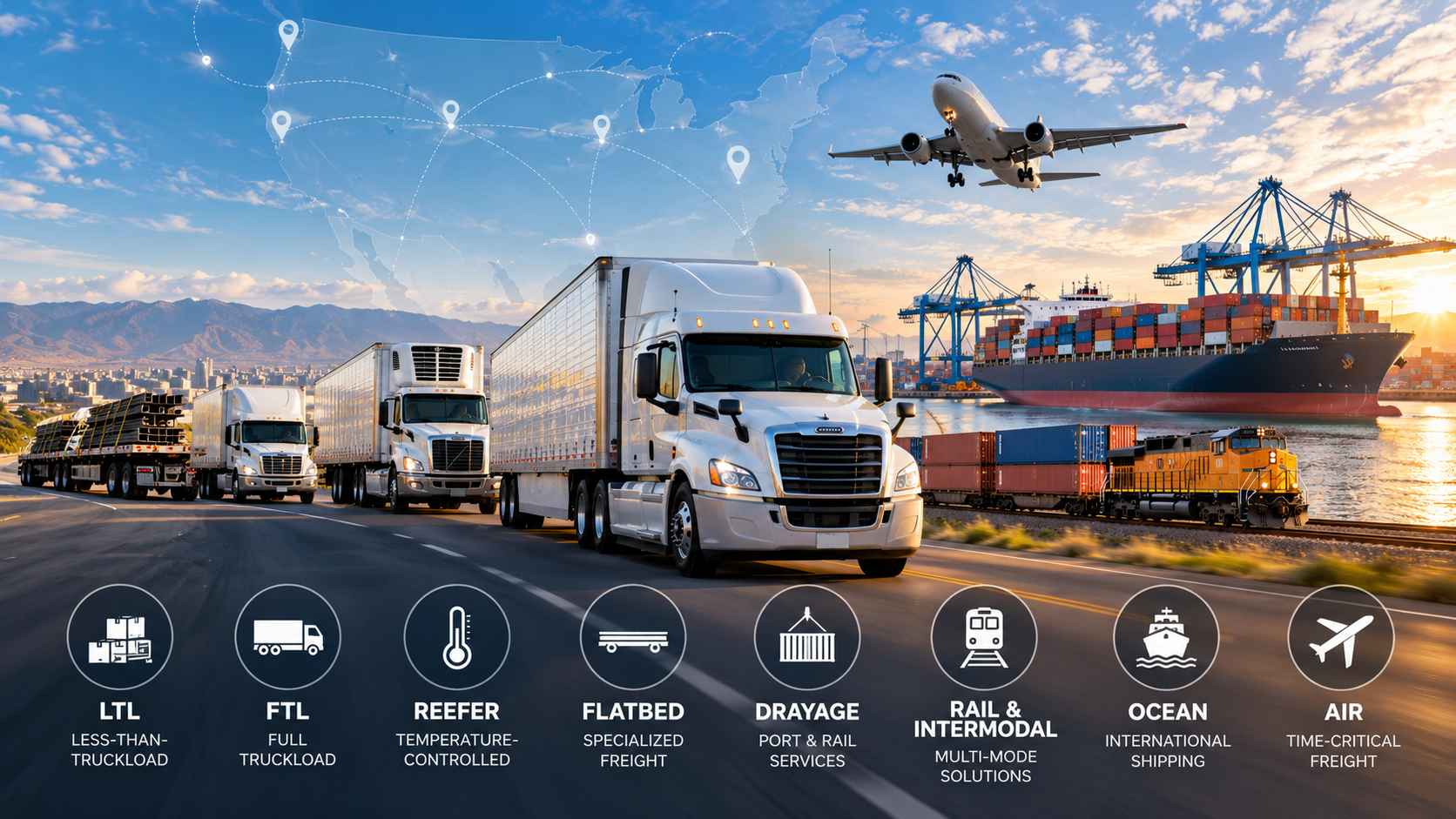
Freight shipping is the transportation of goods that are too large, heavy, specialized or commercially significant for standard parcel delivery. Businesses can move freight by less-than-truckload (LTL), full truckload (FTL), refrigerated truckload, flatbed, drayage, rail, intermodal, ocean freight, air freight and other specialized transportation services.
The right freight shipping method depends on what you are shipping, how much space it requires, where it is going, how quickly it needs to arrive and whether the shipment has special handling, equipment or temperature requirements.
Logistics Xpress is a Las Vegas-based transportation management company and freight broker that helps businesses coordinate domestic and international freight through qualified transportation providers. Our team manages truckload, LTL, refrigerated, flatbed, drayage, rail, intermodal, ocean and air freight while giving customers one point of contact for their transportation needs.
This guide explains the major types of freight shipping, how freight rates are determined, how to choose the right transportation mode and what businesses should evaluate before selecting a freight provider.
What Is Freight Shipping?
Freight shipping is the commercial transportation of goods by truck, rail, ship, aircraft or a combination of transportation modes.
Unlike parcel shipping, which is generally designed around individual packages, freight transportation is commonly used for palletized goods, manufacturing materials, wholesale products, machinery, food and beverage products, containers and larger commercial shipments.
Freight may move directly from origin to destination or pass through terminals, ports, rail ramps, warehouses or other facilities depending on the transportation mode.
Common freight shipping methods include:
- Less-than-truckload (LTL)
- Full truckload (FTL)
- Partial and volume truckload
- Refrigerated freight
- Flatbed and specialized freight
- Drayage
- Rail and intermodal
- Ocean freight
- Air freight
There is no single best freight mode for every shipment. The right choice depends on the freight itself and the shipper's priorities.
What Are the Main Types of Freight Shipping?
Businesses have several ways to move freight. Understanding the differences can help you balance cost, transit time, handling and capacity.
Less-Than-Truckload (LTL) Shipping
LTL shipping allows multiple shippers to share trailer capacity instead of paying for an entire truck.
It is commonly used for palletized freight that does not require a dedicated trailer.
Because several shipments may travel together, LTL freight can move through a network of terminals where it is consolidated and transferred before reaching its destination.
LTL pricing can be influenced by:
- Origin and destination
- Weight
- Pallet dimensions
- Density
- Freight classification when applicable
- Commodity
- Accessorial requirements
- Pickup and delivery conditions
Accurate shipment information is particularly important with LTL because incorrect weight, dimensions, classification or accessorial information can result in billing adjustments.
For a deeper explanation of LTL pricing, see our LTL Pallet Shipping Rates for Manufacturers guide.
You can also learn about one of the most common LTL billing problems in Why Do LTL Shipments Get Reclassified? 7 Causes and How to Prevent Them.
Full Truckload (FTL) Shipping
Full truckload shipping uses dedicated truck capacity for a shipment rather than combining it with traditional LTL freight from multiple shippers.
FTL is often used for larger shipments, but shipment size is not the only reason to choose a dedicated truck.
FTL may also make sense when freight is:
- Time-sensitive
- High value
- Fragile
- Difficult to handle
- Subject to strict appointments
- Temperature controlled
- Large or unusually configured
- Moving on a recurring high-volume lane
Truckload pricing is heavily influenced by the specific transportation lane and available capacity.
Other factors include mileage, equipment, fuel, pickup and delivery requirements, seasonality, market conditions and the amount of time required at each facility.
For a detailed breakdown, read The Complete Guide to FTL Shipping Costs in 2026.
Partial and Volume Truckload
Partial and volume truckload services can provide an alternative when a shipment falls between traditional LTL and a dedicated full truckload.
These options can be useful for larger palletized shipments that do not require the entire trailer but may be difficult or expensive to move through a traditional LTL network.
Potential advantages can include:
- Less terminal handling
- Different pricing structures
- Greater flexibility for larger shipments
- Options for freight that is difficult to stack
- Reduced handling for certain fragile shipments
There is no universal pallet count or weight at which a shipment automatically becomes partial truckload or FTL.
The best option should be evaluated based on the actual shipment, lane, available capacity and total transportation cost.
What Is Refrigerated Freight Shipping?
Refrigerated freight shipping uses temperature-controlled equipment to maintain required transportation conditions for sensitive products.
Refrigerated trailers, commonly called reefers, are used for commodities such as:
- Food
- Beverages
- Produce
- Frozen products
- Meat and seafood
- Dairy products
- Certain pharmaceuticals
- Temperature-sensitive ingredients
- Some industrial products
Reefer shipments require additional planning because the shipper may need to communicate a required setpoint, operating mode, pre-cooling instructions, sanitation requirements and temperature-monitoring procedures.
The refrigeration unit is primarily intended to maintain transportation conditions rather than rapidly cool improperly conditioned product after loading.
For a complete explanation of temperature-controlled transportation, see our Reefer Shipping Guide: Costs, Temperature Control & Carrier Requirements.
Businesses moving food and beverage products can also review our 6 Best Food and Beverage Freight Brokers Compared guide.
What Is Flatbed Freight Shipping?
Flatbed shipping is used for freight that cannot be easily or safely loaded into a standard enclosed trailer.
Instead of an enclosed trailer body, flatbed equipment provides open access that can make loading from the side, rear or above possible depending on the equipment.
Flatbed transportation is commonly used for:
- Machinery
- Steel
- Building materials
- Industrial equipment
- Construction products
- Large components
- Oversized freight
- Freight requiring crane loading
Specialized equipment can include standard flatbeds, step decks, Conestogas and other trailer configurations.
Dimensions and weight are particularly important when quoting specialized freight because oversized or overweight shipments may require permits, route planning, escorts or specialized equipment.
What Is Drayage?
Drayage is short-distance freight transportation that commonly connects ports, rail ramps, warehouses and distribution facilities.
Although the mileage may be relatively short, drayage can be operationally complex.
A container movement may involve:
- Port or rail availability
- Pickup appointments
- Terminal requirements
- Container numbers
- Chassis availability
- Free-time deadlines
- Storage
- Demurrage
- Detention
- Overweight considerations
- Warehouse appointments
- Empty-container returns
Drayage is an important part of international and intermodal supply chains because it connects long-distance ocean or rail transportation with the shipper's warehouse or final destination.
For example, an imported container arriving through Southern California may require drayage from the port before the freight can be delivered to a warehouse or transferred into another domestic transportation mode.
What Is Rail and Intermodal Freight?
Intermodal freight uses more than one transportation mode—commonly truck and rail—to move a shipment from origin to destination.
A typical domestic intermodal shipment may involve:
- A truck moving the container or trailer from the shipper to a rail ramp.
- Rail transportation for the long-haul portion.
- Another truck completing delivery from the destination rail ramp.
Intermodal can be worth evaluating for certain long-distance freight lanes when the shipper has enough transit-time flexibility.
The best choice between over-the-road truckload and intermodal depends on:
- Lane
- Transit requirements
- Freight characteristics
- Rail service availability
- Drayage requirements
- Current truck and rail pricing
- Pickup and delivery flexibility
Rail is not automatically less expensive or better than truckload on every long-distance shipment. Each lane should be evaluated individually.
What Is Ocean Freight?
Ocean freight moves goods internationally by vessel, most commonly in shipping containers.
Common ocean freight options include:
Full Container Load (FCL)
FCL gives a shipper use of a container for its cargo.
Common container sizes include 20-foot and 40-foot equipment, although container types vary according to the freight.
Less-Than-Container Load (LCL)
LCL allows smaller international shipments to share container capacity with other cargo.
International ocean transportation can involve considerably more than the vessel movement itself.
A complete shipment may require coordination among:
- Overseas origin
- Export handling
- Ocean carrier
- Port
- Customs process
- Drayage provider
- Warehouse
- Domestic transportation provider
- Final receiver
Strong communication across these handoffs is important because a delay at one point can affect the rest of the shipment.
What Is Air Freight?
Air freight uses aircraft to move cargo when speed or service requirements justify the higher transportation cost.
Air freight can be useful for:
- Time-critical inventory
- High-value products
- Urgent replacement parts
- Production-critical components
- International shipments with tight deadlines
Air freight is generally more expensive than ocean transportation, so the decision often comes down to the value of time.
For some shipments, avoiding a production shutdown or inventory shortage can make faster transportation economically worthwhile even when the freight rate is higher.
How Do You Choose the Right Freight Shipping Method?
Choose a freight shipping method by comparing shipment size, commodity, distance, transit requirements, handling risk, equipment needs and total transportation cost.
Start with these questions:
How Much Freight Are You Shipping?
Determine:
- Number of pallets or handling units
- Total weight
- Dimensions
- Total space required
Shipment size helps narrow the available modes but should not be the only factor.
What Are You Shipping?
Commodity characteristics can determine what equipment and handling procedures are appropriate.
Consider whether the freight is:
- Fragile
- High value
- Perishable
- Temperature sensitive
- Hazardous
- Oversized
- Difficult to stack
- Sensitive to repeated handling
How Quickly Does It Need to Arrive?
A shipment with a flexible delivery window may have more transportation options than a production-critical shipment with a firm deadline.
How Much Handling Can the Freight Tolerate?
Traditional LTL may involve terminal transfers.
A dedicated truck generally reduces intermediate handling.
Fragile, high-value or difficult-to-handle freight may justify a different transportation mode even when a less expensive option exists.
Does the Shipment Require Special Equipment?
Determine whether the freight requires:
- Dry van
- Refrigerated trailer
- Flatbed
- Step deck
- Conestoga
- Specialized trailer
- Container
- Intermodal equipment
Choosing the correct equipment before quoting reduces the risk of rejected trucks and failed pickups.
How Much Does Freight Shipping Cost?
There is no standard freight shipping price because rates depend on the shipment, transportation mode, lane, equipment, market conditions and service requirements.
Two shipments traveling the same distance can have very different transportation costs.
LTL Pricing
LTL rates may depend on:
- Origin and destination
- Weight
- Dimensions
- Density
- Freight classification
- Carrier
- Accessorial services
- Pickup and delivery requirements
For a broader look at pallet transportation costs across modes, read our Complete Guide to Pallet Shipping Costs in 2026.
FTL Pricing
Truckload pricing depends more heavily on:
- Lane
- Mileage
- Available capacity
- Equipment
- Fuel
- Market balance
- Appointments
- Loading and unloading requirements
- Seasonality
This is why comparing freight solely by mileage can be misleading.
Specialized Freight Pricing
Refrigerated, flatbed, oversized, drayage, intermodal, ocean and air shipments introduce additional variables specific to those transportation modes.
The best way to price freight is to provide complete shipment information and compare appropriate transportation options rather than relying on a generic cost-per-mile or cost-per-pallet assumption.
What Information Do You Need for a Freight Quote?
An accurate freight quote starts with accurate shipment information.
Before requesting pricing, gather:
- Origin ZIP code or full location
- Destination ZIP code or full location
- Pickup date
- Required delivery date
- Commodity
- Total weight
- Number of pallets or handling units
- Dimensions
- Required equipment
- Freight class or NMFC information when applicable
- Temperature requirements when applicable
- Pickup requirements
- Delivery requirements
- Appointment information
- Special handling requirements
Incomplete information can result in inaccurate pricing, unsuitable equipment or billing adjustments after the shipment moves.
What Are Freight Accessorial Charges?
Accessorial charges are transportation charges associated with services or conditions beyond the basic movement of freight.
Examples can include:
- Liftgate service
- Residential delivery
- Limited-access locations
- Inside delivery
- Detention
- Layovers
- Redelivery
- Truck ordered not used
- Additional stops
- Specialized appointment requirements
- Storage
Not every shipment will incur these charges.
The best way to avoid unexpected accessorial costs is to communicate the pickup and delivery conditions accurately before the shipment is booked.
What's the Difference Between a Freight Carrier, Freight Broker and Transportation Management Company?
These terms describe different roles within freight transportation.
Freight Carrier
A motor carrier physically transports freight using trucks and equipment operating under its authority.
A carrier may specialize in certain equipment, regions or transportation services.
Freight Broker
A freight broker arranges transportation between a shipper and qualified motor carriers rather than physically hauling the freight itself.
Brokers can give shippers access to capacity across multiple carriers, equipment types and regions.
Transportation Management Company
A transportation management company can take a broader role in planning, coordinating, monitoring and improving a shipper's transportation operation.
That can include:
- Mode selection
- Carrier sourcing
- Rate management
- Shipment execution
- Tracking
- Appointment coordination
- Exception management
- Documentation
- Billing
- Transportation analysis
Logistics Xpress operates as a transportation management company and freight broker, coordinating transportation through qualified providers while giving customers one team responsible for managing the shipment.
How Should Businesses Choose a Freight Shipping Provider?
Choose a freight provider based on service capability, carrier quality, communication, visibility, lane coverage and exception management—not price alone.
Important areas to evaluate include:
Mode Coverage
Can the provider support the types of freight you actually move?
A shipper using LTL today may need truckload, refrigerated freight, drayage or intermodal tomorrow.
Carrier Vetting
When a broker or transportation management company is arranging truck capacity, it should have a process for evaluating the carriers used to transport freight.
Communication
Determine who you contact when something changes.
A technology platform can provide shipment information, but businesses still need a clear escalation path when a truck is late, an appointment changes or another exception occurs.
Visibility
Useful freight technology should make it easier to access:
- Quotes
- Shipment status
- Tracking
- Documents
- Invoices
- Shipment history
Exception Management
Ask what happens when transportation does not go according to plan.
Strong freight management is not just about reporting a problem. It is about identifying the exception, communicating it and coordinating the next step.
Performance
For recurring truckload freight, evaluate actual provider performance instead of relying only on promises made during the sales process.
Our How Manufacturers Evaluate FTL Carrier Reliability: 8 Metrics That Matter guide explains how to measure transportation performance.
Before selecting a truckload provider, you can also use our What to Check Before Choosing an FTL Provider checklist.
Why Does Lane-Specific Freight Strategy Matter?
Freight transportation should be evaluated by lane because capacity, pricing and service risk can change from one origin-destination pair to another.
A provider that performs extremely well on one lane may not be the best fit for another.
Important lane-level factors include:
- Available carrier capacity
- Equipment availability
- Freight balance
- Pickup market
- Delivery market
- Appointment requirements
- Seasonal conditions
- Shipment frequency
- Service risk
For a deeper explanation, read Choosing FTL Carriers by Lane and Service Risk.
Businesses with recurring truckload volume should also consider how primary, secondary and backup capacity fit together. Our Building a Resilient FTL Carrier Mix guide explains that strategy.
How Does Location Affect Freight Shipping?
Freight markets are regional, so where a shipment originates and delivers can affect capacity, price and transportation options.
Large manufacturing, distribution and port markets generate different freight flows than areas with less outbound volume.
For example, freight moving between California and the Midwest involves different capacity dynamics than a local Nevada shipment.
Businesses shipping that corridor can see our 6 Best California to Midwest FTL Brokers comparison.
For businesses operating in Southern Nevada, our Las Vegas Freight Shipping & 3PL Services: A Local Guide for Nevada Businesses covers local transportation options and regional considerations.
How Does Freight Tracking Work?
Freight tracking provides visibility into a shipment's location, status and important transportation milestones.
The exact tracking method depends on the transportation mode and provider.
Tracking may use:
- GPS or telematics
- Driver location data
- Carrier systems
- Terminal updates
- Rail milestones
- Port or container status
- Transportation-management systems
Visibility is useful, but tracking alone does not solve transportation problems.
The greater value comes from combining visibility with exception management so someone can act when a shipment falls behind schedule or another issue occurs.
What Freight Technology Should Shippers Look For?
Freight technology should make transportation easier to manage rather than simply provide another system to check.
Useful capabilities can include:
- Freight quoting
- Shipment tracking
- Billing and invoices
- Document access
- Shipment history
- Centralized shipment information
Logistics Xpress customers can receive access to a secure transportation portal for quoting, real-time tracking, invoices, shipment documents and shipment history.
The technology is supported by a dedicated logistics contact who can step in when a shipment requires human attention.
Why Use Logistics Xpress for Freight Shipping?
Logistics Xpress is a Las Vegas-based transportation management company that helps businesses manage freight across the U.S. and international markets through one transportation team, rather than coordinating separate providers for every type of shipment. Whether a shipment moves by truck, rail, ocean or air, accurate shipment information helps determine the appropriate mode, equipment, capacity and pricing.
Our transportation capabilities include:
- Full truckload
- Dry van
- Refrigerated and temperature-controlled freight
- Flatbed and specialized freight
- Less-than-truckload
- Volume and partial truckload
- Drayage and port services
- Rail and intermodal
- Ocean freight
- International air freight
Our approach combines transportation technology with direct human support.
Customers can receive access to centralized quoting, tracking, invoices, documents and shipment history while maintaining a dedicated point of contact who understands their lanes, freight and operational priorities.
From one pallet to recurring truckloads, port containers or international freight, the objective is the same: choose the right transportation solution, coordinate the providers involved, monitor execution and communicate when something changes.
Freight Shipping Checklist
Before booking a freight shipment, confirm:
- Origin
- Destination
- Pickup date
- Required delivery date
- Commodity
- Total weight
- Pallet or handling-unit count
- Dimensions
- Required equipment
- Freight class or NMFC information when applicable
- Temperature requirements when applicable
- Pickup conditions
- Delivery conditions
- Appointment requirements
- Special handling requirements
- Insurance or value considerations
- Required documentation
Providing this information at the beginning makes it easier to select the correct mode, source appropriate capacity and produce an accurate quote.
Frequently Asked Questions About Freight Shipping
What is freight shipping?
Freight shipping is the commercial transportation of goods by truck, rail, ship, aircraft or a combination of transportation modes. It is commonly used for palletized products, commercial goods, manufacturing materials, machinery, containers and other shipments that are larger or more specialized than standard parcels.
What is the cheapest way to ship freight?
There is no single cheapest freight method for every shipment. The lowest-cost appropriate option depends on shipment size, weight, dimensions, distance, commodity, transit requirements and available transportation services.
Smaller palletized shipments may fit LTL, while larger shipments may be better suited to partial or full truckload. Long-distance freight with flexible transit requirements may also be evaluated for intermodal service.
What is the difference between LTL and FTL shipping?
LTL generally combines freight from multiple shippers within a carrier network, while FTL uses dedicated truck capacity for a shipment.
LTL can be economical for smaller palletized shipments. FTL can provide less handling, more direct transportation and greater control for larger or operationally sensitive freight.
How much does it cost to ship a pallet?
There is no standard price to ship a pallet. Cost depends on origin, destination, weight, dimensions, transportation mode, classification when applicable and pickup or delivery requirements.
For more information, read our Complete Guide to Pallet Shipping Costs in 2026.
How much does full truckload shipping cost?
FTL rates vary according to the lane, mileage, equipment, available capacity, fuel, appointments, seasonality and current market conditions.
See our Complete Guide to FTL Shipping Costs in 2026 for a detailed explanation.
What is reefer freight?
Reefer freight is cargo transported using refrigerated equipment designed to maintain controlled conditions during transit.
It is commonly used for food, beverages, produce, frozen products and other temperature-sensitive commodities.
Read our Reefer Shipping Guide for more information.
What is drayage shipping?
Drayage is short-distance transportation that commonly connects ports or rail ramps with warehouses, distribution centers and other transportation facilities.
It is an important part of containerized ocean and intermodal transportation.
What is intermodal freight?
Intermodal freight uses multiple transportation modes, commonly truck and rail, to move a shipment from origin to destination.
Truck transportation generally handles the first and final portions while rail handles the long-distance portion.
What's the difference between a freight broker and a carrier?
A motor carrier physically transports freight. A freight broker arranges transportation between a shipper and qualified motor carriers.
Can one logistics provider handle multiple freight modes?
Yes. Transportation management companies can coordinate multiple freight modes through one management relationship.
Logistics Xpress manages truckload, LTL, refrigerated, specialized, drayage, rail, intermodal, ocean and international air transportation.
How do I get a freight shipping quote?
Start by providing the origin, destination, dates, commodity, weight, dimensions, pallet count, equipment requirements and any special pickup or delivery requirements.
Request a freight shipping quote from Logistics Xpress.
Need Help Choosing the Right Freight Shipping Option?
Choosing the right transportation mode should not require guessing whether a shipment belongs on LTL, truckload, refrigerated equipment, rail or another service.
Logistics Xpress can review your shipment requirements, lane and service priorities and help coordinate an appropriate transportation solution through qualified providers.
Whether you are moving one pallet, recurring truckloads, temperature-controlled freight, port containers or international cargo, our team provides one point of contact from quote through delivery.
Contact Logistics Xpress to discuss your freight or request a quote.