
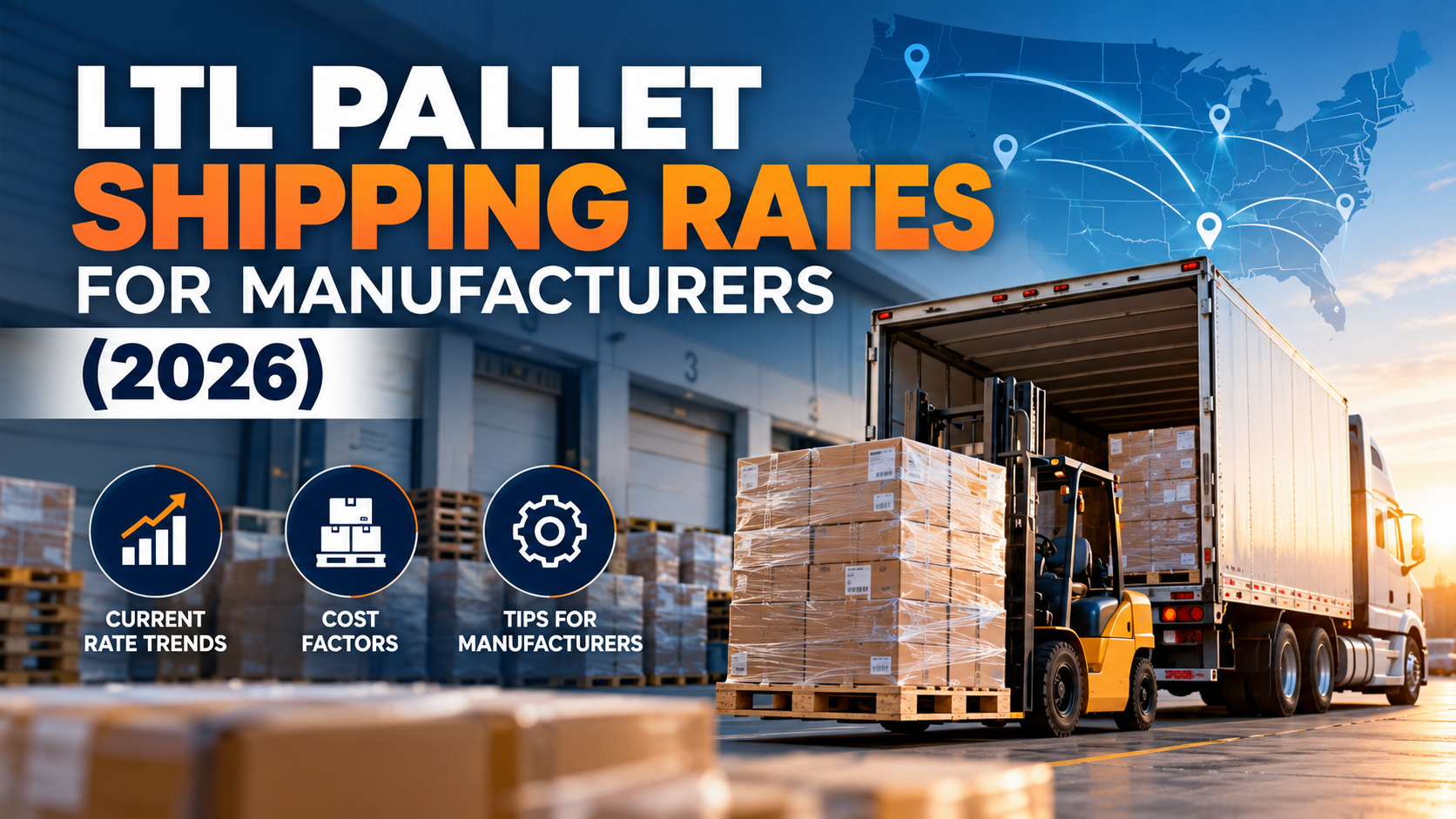
Your manufacturing line runs on schedule until a pallet misses its delivery window. The freight invoice shows a number that does not match the quote. And nobody can explain the gap between what was quoted and what was charged. That disconnect usually traces back to LTL pallet shipping rates that were never broken down clearly at the quoting stage.
LTL pallet shipping is one of the most cost-effective ways to move palletized raw materials, components, and finished goods without paying for an entire trailer. For manufacturers and distributors shipping one to six pallets per load, understanding the variables behind your rate is the difference between a predictable freight budget and a monthly billing dispute.
This guide covers every factor that determines your LTL pallet rate, from freight class and lane direction to accessorial charges and fuel surcharges. You will also find practical steps to get accurate quotes and reduce cost per pallet across your shipping lanes. For a broader look at LTL, FTL, refrigerated, drayage and other transportation modes, see our Freight Shipping Guide.
Key Takeaways: LTL Pallet Shipping Rates
- Freight class, distance, weight, and accessorial charges are the four primary drivers behind every LTL pallet shipping rate.
- The 2025 NMFC density-based classification changes directly affect how your pallets are rated and billed.
- Accessorial fees for liftgate, limited access, and residential delivery can exceed linehaul costs on shorter lanes.
- Logistics Xpress provides transparent pallet rates with rebill audits and a dedicated point of contact for manufacturers.
- Quoting across LTL, volume LTL, and partial truckload on six-plus pallet shipments often reveals significant savings.
What Are LTL Pallet Shipping Rates?
LTL pallet shipping rates are the per-shipment charges you pay when your palletized freight shares trailer space with other shippers' goods. Carriers calculate these rates based on weight, freight class, distance, and delivery conditions rather than a flat per-pallet number.
For manufacturers, LTL is the standard mode for shipments between one and six pallets. You avoid paying for an entire trailer while still moving freight through a structured carrier network with terminal handling, cross-docking, and scheduled linehaul runs between hubs.
The rates you receive depend on the combination of variables described in the sections below. Each one interacts with the others, which is why identical pallets shipped to different destinations on the same day can produce very different invoices.
How Freight Class Affects Your Pallet Rate
Freight class is the single largest variable in your LTL rate. The National Motor Freight Classification (NMFC) assigns every commodity a class between 50 and 500. Class 50 freight is the densest and easiest to handle, carrying the lowest rate per hundredweight. Class 500 carries the highest.
The cost difference between classes is substantial. A Class 50 pallet on a given lane can cost roughly a third of what a Class 300 pallet costs with the same weight and origin-destination pair. Getting classification right is the foundation of an accurate quote.
For manufacturers shipping raw materials, machined parts, or packaged goods, your commodity's density, stowability, handling difficulty, and liability all factor into the assigned class. Knowing your class before you request a freight quote prevents reclassification charges downstream.
How the 2025 NMFC Density-Based Changes Affect Manufacturers
On July 19, 2025, the National Motor Freight Traffic Association restructured the NMFC around a standardized density-based approach. According to FreightWaves reporting on the changes, roughly 2,000 items were carved out from a list of 5,000 under review, expanding density-based subprovisions from 11 to 13 categories.
This shift affects manufacturers directly. If your classification practices were established before July 2025, some of your frequently shipped commodities may now carry different class assignments. Incorrect classification leads to reclassification penalties and inflated invoices on every shipment that moves under the wrong class.
Recalculating density on your top-shipped SKUs against the current rules is a practical first step. Measure each pallet at its widest and tallest points after wrapping, divide weight by cubic feet, and compare the result against the updated NMFC density brackets.
How Distance and Lane Direction Influence LTL Rates
Longer moves cost more in absolute terms but less per mile. A regional move under 300 miles typically produces a lower total rate than a cross-country shipment. However, the per-mile cost on short-haul lanes is often higher because terminal handling and pickup costs are spread over fewer miles.
Lane direction matters as much as distance. Freight lanes are not symmetrical. A shipment from Chicago to Dallas and from Dallas to Chicago can price differently on the same day because capacity flows unevenly between markets.
Lanes running into markets where trucks are scarce (headhaul lanes) price higher. Lanes running out of markets where trucks are waiting for loads (backhaul lanes) price lower. If your manufacturing facility ships into a known headhaul market, checking rates in both directions or shifting pickup timing by a day can produce measurable savings.
How Weight and Weight Breaks Shape LTL Pallet Rates
LTL freight is priced by the hundredweight (CWT). Your carrier divides shipment weight by 100 and multiplies by a rate determined by freight class and lane. A 900 lb shipment equals nine hundredweight units.
Two features of CWT pricing work in your favor as a manufacturer. First, the rate per hundredweight drops as weight increases. Heavier shipments cost more in total but less per pound. Consolidating two small pallets into one shipment on the same lane often costs less than shipping them separately.
Using Weight Breaks to Reduce Your Rate
Carrier tariffs include published weight breaks, commonly at 500, 1,000, 2,000, 5,000, and 10,000 lbs. Crossing a weight break reprices the entire shipment at a lower per-hundredweight band.
This creates a practical tactic for production teams: if your pallet sits just below a weight break, ask your logistics team to rate the shipment at the break minimum. A 1,850 lb shipment rated at the 2,000 lb break can cost less than the same shipment rated at actual weight. Carriers allow this approach. It is called shipping at a deficit weight.
Check this on any manufacturing shipment landing within 15 percent below a break. The savings compound across recurring lanes and weekly shipping schedules.
Accessorial Charges That Inflate Manufacturer Pallet Invoices
Accessorials are fees for services beyond standard dock-to-dock transportation. They are the most common reason a quote and an invoice disagree. Declaring accessorials at the time of quoting is always less expensive than having them discovered by a driver at delivery.
Common accessorial charges on manufacturer pallet shipments include liftgate delivery, residential pickup or delivery, inside delivery, limited access location surcharges, delivery appointment fees, and redelivery charges after a failed attempt.
How Accessorial Fees Stack Up for Manufacturers
Liftgate charges typically run between $75 and $200 per end. Limited access fees, which apply to locations such as construction sites, military bases, and gated facilities, typically add $75 to $200 per occurrence. Delivery appointment fees and notification charges add another layer.
On a single pallet moving between two commercial manufacturing docks, none of these apply. Add a liftgate, a limited access surcharge, and a delivery appointment to that same shipment, and the accessorial total can exceed the linehaul cost on shorter lanes.
Manufacturers shipping to job sites, retail locations with restricted hours, or facilities without dock equipment should verify accessorial requirements before booking every shipment.
Limited Access Locations: Broader Than You Expect
Limited access sounds like a difficult rural road. In carrier tariffs, it usually means something more ordinary: schools, churches, construction sites, military bases, self-storage facilities, strip malls, and any location with restricted hours or gated entry.
Manufacturers get caught by this charge when shipping to customer sites that appear standard but meet the carrier's definition of limited access. Reviewing your carrier's actual limited access list once will change how you quote several of your regular destinations.
How Fuel Surcharges Affect LTL Pallet Rates in 2026
Fuel surcharges are indexed to the national average on-highway diesel price published weekly by the U.S. Energy Information Administration. When diesel prices rise, the surcharge percentage applied to your linehaul rate rises with it.
According to the Bureau of Transportation Statistics, truck transportation costs increased 15.2% from April 2025 to April 2026. That increase is driven in part by elevated diesel prices and is reflected directly in the fuel surcharge line on your pallet freight invoices.
When comparing quotes across different periods, account for fuel surcharge fluctuations before concluding that your carrier raised base rates. Much of the invoice-to-invoice variation manufacturers experience traces back to diesel, not to a change in the underlying rate structure.
What Is the Current LTL Market Doing in 2026?
The U.S. LTL market was valued at approximately $114 billion in 2025 and is projected to reach $118.68 billion in 2026, according to Mordor Intelligence market research (2026). E-commerce fulfillment, reshoring of domestic manufacturing, and omnichannel retail are reshaping shipment profiles across the country.
Capacity dynamics shifted after Yellow Corporation's exit in July 2023, which removed roughly 10% of market capacity. The remaining carriers absorbed that volume, and pricing discipline has held. LTL contract rates have climbed more than 12% since Yellow's closure, according to the U.S. Bureau of Labor Statistics LTL producer price index.
For manufacturers, this means rate increases have been gradual but persistent. Planning freight budgets around current rate trends rather than historical averages will produce more accurate cost projections for your next fiscal year.
LTL vs. Volume LTL vs. Partial Truckload for Manufacturing Shipments
One to five pallets is almost always an LTL shipment. As pallet count increases, the pricing logic shifts. Knowing where the mode boundaries fall prevents your facility from overpaying on outbound freight.
Between six and twelve pallets, LTL, volume LTL, and partial truckload can all produce different rates depending on lane, density, and timing. Above twelve pallets, a full truckload is typically the most cost-effective option for manufacturers.
Why the Six-to-Twelve Pallet Range Matters for Manufacturers
The six-to-twelve pallet range is where cost differences between modes are largest. Volume LTL rates can undercut standard LTL significantly on this pallet count. Partial truckload may beat both depending on the lane and whether the shipment can bypass terminals.
Most manufacturing shipping teams quote only one mode. Quoting all three on shipments in this range often uncovers several hundred dollars in savings per load. Logistics Xpress coordinates capacity across multiple carrier partners and modes to identify the option that fits your lane, timeline, and pallet count.
How to Get Accurate LTL Pallet Shipping Quotes
An accurate quote starts with accurate inputs. The most common source of quote-to-invoice gaps is incomplete or incorrect shipment information at the time of booking. Carriers verify dimensions and weight at terminals using automated dimensioners, and any discrepancy triggers a re-rate.
Getting it right the first time requires attention to a short list of inputs that manufacturing teams can measure on the dock before the shipment leaves.
Measure the Pallet as It Will Actually Travel
Measure after the pallet is wrapped, stacked, and ready to ship. Include the pallet itself, any overhang, and the height of any stretch wrap dome or corner boards. Measure at the widest and tallest points. Round up, not down.
Weigh on a calibrated floor scale. Product weights from a spec sheet do not account for the pallet, wrap, corner boards, slip sheets, or dunnage. Under-declaring weight triggers a re-weigh at the carrier terminal and a corrected invoice. A quote that is $15 high at booking is far less expensive than a reclassification surcharge after delivery.
Declare Every Accessorial at Quote Time
Before booking, confirm two things with the receiver: is there a dock, and is there a forklift? If the answer to either is no, you need a liftgate, a residential surcharge, or both. Declaring these up front costs less than having them added after delivery.
Put the NMFC item number on the bill of lading, not just the class. A bare class number invites reclassification. An item number states your reasoning and provides a reference point if you need to dispute a re-rate.
How Rebill Audits Protect Your Manufacturing Freight Budget
Rebill disputes are among the most common billing issues in LTL shipping. They occur when a carrier re-rates a shipment after delivery based on dimensions, weight, or classification that differ from the original bill of lading.
Logistics Xpress includes rebill audits as part of its LTL shipping process. Your shipment invoices are reviewed for duplicate charges, incorrect accessorials, and wrong fuel surcharges before they reach your accounts payable team. Catching these discrepancies early keeps freight spend predictable and reduces the hours your team spends resolving billing disputes.
How Logistics Xpress Simplifies LTL Pallet Rates for Manufacturers
Logistics Xpress gives manufacturers one accountable team across LTL, volume LTL, and full truckload modes. For pallet shipments, that means transparent pallet rates through an automated quoting system, proactive exception management when shipments deviate from plan, and a dedicated point of contact who understands your freight profile.
Your Logistics Xpress shipment portal consolidates quoting, tracking, billing, and documentation in one location. Your dedicated contact remains available to coordinate exceptions, interpret rate discrepancies, and keep freight on schedule. Self-service when you want it. A logistics professional when you need one.
For manufacturers with recurring LTL lanes and consistent pallet volumes, Logistics Xpress also provides customer-specific volume pricing built around your actual shipping patterns rather than standard tariff rates.
How to Reduce LTL Pallet Shipping Costs: Practical Steps
Cost reduction in pallet shipping comes from accuracy and mode selection, not from negotiating harder on a single rate. Five practices capture the majority of available savings for manufacturing shipping teams.
First, recalculate the freight class on your top-shipped SKUs against the current density-based NMFC rules. Misclassification carries forward on every shipment. Second, confirm dock access and forklift availability at the delivery location before booking.
Third, consolidate pallets moving to the same destination on the same day into a single bill of lading. Fourth, check weight break thresholds on every shipment. A shipment landing just below a break is often cheaper when rated at the break minimum.
Fifth, quote the six-to-twelve pallet range across LTL, volume LTL, and partial truckload. The right mode varies by lane, and checking all three options on each shipment in this range often reduces cost per pallet by a meaningful margin.
How Carrier Liability Works for Manufacturer Pallet Freight
Carrier liability for lost or damaged freight is capped, and the cap is stated in the carrier's tariff as a dollar amount per pound. Caps commonly range from under a dollar to a few dollars per pound, regardless of what is on the pallet.
Consider a 900 lb pallet carrying $40,000 in precision-machined components with a carrier liability cap of $2.00 per pound. Maximum recovery from the carrier is $1,800. The remaining $38,200 is yours to absorb unless you carry separate cargo insurance.
For manufacturers shipping high-value goods, separate cargo insurance is worth purchasing. The cost is typically a fraction of one percent of declared value. Carrier liability is also fault-based. Insufficient packaging, including under-wrapped pallets that shift in transit, can result in a denied claim. For a deeper breakdown of individual cost components, see our complete guide to pallet shipping costs.
In Summary: Controlling Your LTL Pallet Freight Spend as a Manufacturer
LTL pallet shipping rates are driven by freight class, distance, weight, delivery conditions, and fuel. You control most of these variables. Manufacturers who maintain predictable freight budgets are the ones who measure accurately, declare accessorials up front, and compare modes when pallet counts reach the volume threshold.
Accurate classification under the current density-based NMFC rules, honest weight declarations, and upfront accessorial disclosure eliminate the most common sources of invoice surprises. When you need capacity, transparent pricing, and a team that manages exceptions before they become problems, contact Logistics Xpress to request a pallet rate.
Built.To.Deliver.
FAQs About LTL Pallet Shipping Rates for Manufacturers
How much does it cost to ship one pallet by LTL?
A single pallet typically costs between $150 and $900 depending on freight class, distance, and delivery conditions. Short regional moves between commercial docks land at the lower end. Cross-country shipments requiring liftgate service reach the higher range.
What is freight class and why does it affect LTL pallet rates?
Freight class is an NMFC rating from 50 to 500 based on density, handling, stowability, and liability. Lower classes carry lower rates per hundredweight. A misclassified pallet can cost 30% to 60% more than the same shipment with the correct class. Logistics Xpress helps manufacturers verify classification before booking to avoid reclassification penalties.
How do the 2025 NMFC changes affect my LTL pallet rates?
The July 2025 NMFC restructuring expanded density-based subprovisions from 11 to 13. Commodities previously classified by commodity description may now carry a different class based on measured density. Recalculating your top-shipped SKUs against the updated rules prevents misclassification charges on recurring shipments.
How can manufacturers avoid surprise charges on pallet shipments?
Declare all accessorial services when quoting, measure and weigh pallets accurately before booking, and include the NMFC item number on your bill of lading. Logistics Xpress provides rebill audits that catch billing errors before they reach your accounts payable team, keeping your freight budget predictable.
When should a manufacturer switch from LTL to full truckload?
The crossover point is typically between six and twelve pallets. In that range, quoting LTL, volume LTL, and partial truckload side by side often reveals savings of several hundred dollars per load. Logistics Xpress coordinates across modes to find the right fit for your lane, volume, and delivery timeline.
Does Logistics Xpress offer instant LTL pallet shipping quotes?
Logistics Xpress provides automated quoting through its customer portal. You enter shipment details, review pricing, and receive a rate that includes a clear breakdown of linehaul, fuel surcharge, and applicable accessorial charges. A dedicated logistics professional is also available to review your quote and answer questions.