
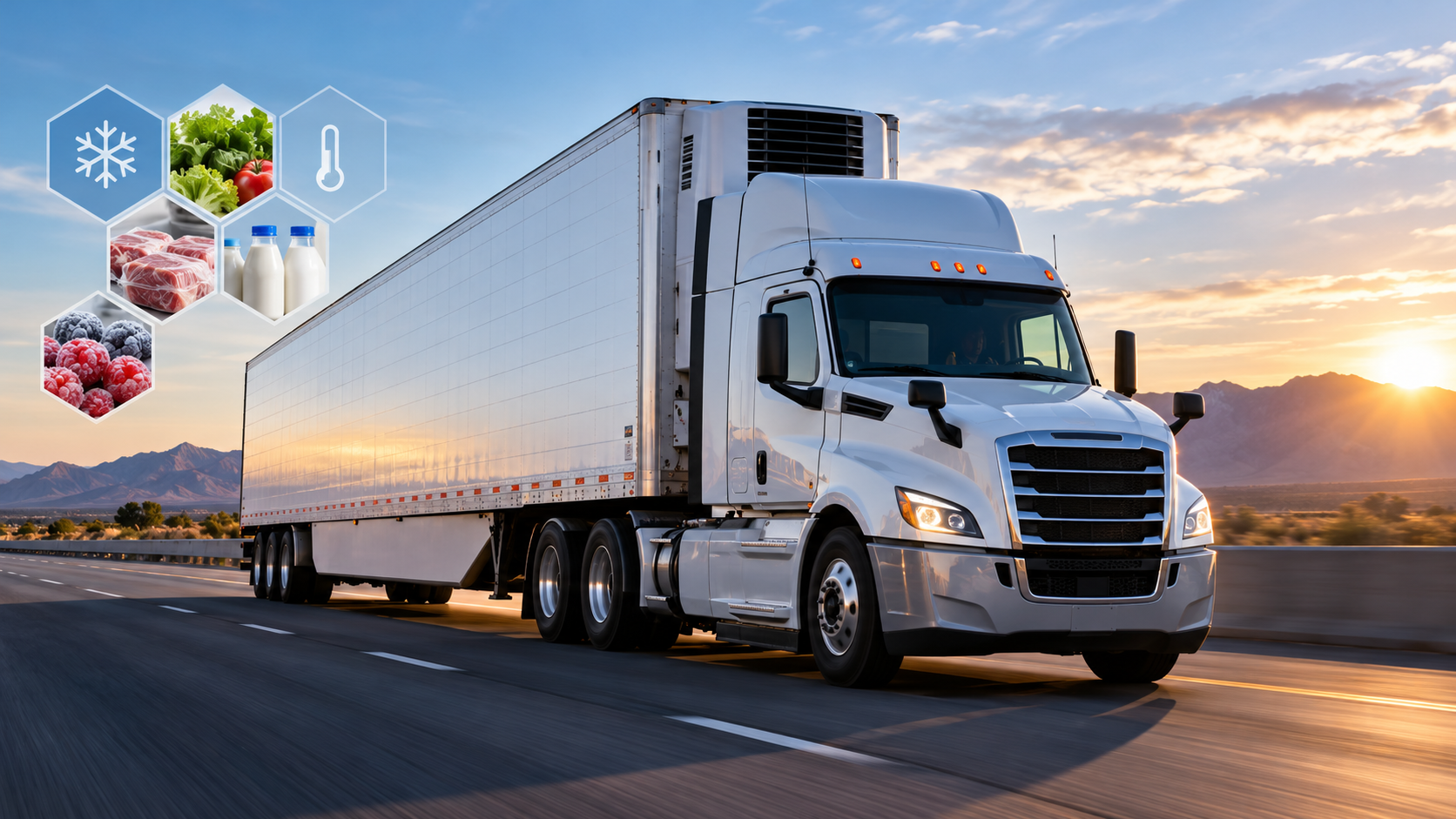
Reefer shipping is the transportation of freight in refrigerated equipment designed to maintain a controlled temperature during transit. It is commonly used for food, beverages, produce, frozen products, pharmaceuticals and other commodities that can be damaged or become unsafe when exposed to the wrong temperature.
Unlike standard dry van freight, refrigerated shipping requires more than finding an available truck. Shippers may need to specify an operating temperature, confirm equipment condition, coordinate pre-cooling when required, monitor shipment conditions and maintain documentation appropriate for the commodity.
This guide explains how refrigerated freight works, what affects reefer shipping costs, how temperature-controlled loads should be prepared and what shippers should check before booking a reefer carrier. Refrigerated transportation is one part of a broader freight strategy. Our Freight Shipping Guide explains how reefer compares with LTL, FTL, drayage, rail and other freight modes.
What Is Reefer Shipping?
Reefer shipping is freight transportation using refrigerated equipment that can maintain a specified temperature range during transit.
A reefer trailer looks similar to a standard enclosed dry van but includes a refrigeration unit and insulated trailer body. The refrigeration system controls the environment inside the trailer while the freight moves from pickup to delivery.
Reefer equipment is commonly used for:
- Fresh and frozen foods
- Produce
- Meat and seafood
- Dairy products
- Beverages
- Certain pharmaceuticals
- Temperature-sensitive ingredients
- Some chemicals and industrial products
- Other commodities requiring controlled transportation conditions
The required operating conditions depend on the specific commodity. A frozen product, fresh produce shipment and temperature-sensitive ingredient may all require different handling procedures.
That is why the shipper should communicate the commodity, required temperature and any special operating instructions before the carrier is dispatched.
How Does a Reefer Trailer Work?
A reefer trailer uses an engine-driven refrigeration unit, insulated walls and controlled airflow to maintain the required environment inside the trailer.
The refrigeration unit circulates conditioned air through the trailer. Proper airflow is important because the system needs to move air around the freight rather than simply cool the area closest to the refrigeration unit.
Several factors can affect the trailer's ability to maintain the required conditions:
- Product temperature at loading
- Trailer pre-cooling
- Outside temperature
- Airflow around the freight
- Pallet placement
- Loading pattern
- Door openings
- Trailer condition
- Refrigeration-unit performance
- Temperature setpoint and operating mode
Reefer trailers are primarily designed to maintain product temperature, not rapidly bring warm product down to the desired shipping temperature.
For that reason, freight that must ship cold should generally be brought to the appropriate product temperature before loading according to the commodity's handling requirements.
What Is a Reefer Setpoint?
A reefer setpoint is the operating temperature programmed into the refrigeration unit for the shipment.
For example, a shipper may provide instructions requiring a specific operating temperature for the load.
The correct setpoint should come from the shipper or other party responsible for the product specifications—not from a driver, broker or carrier guessing what temperature a commodity normally requires.
Products within the same general category can have different transportation requirements.
Before dispatch, the shipping instructions should clearly identify:
- Commodity
- Required operating temperature
- Whether the product is chilled or frozen
- Whether pre-cooling is required
- Continuous or cycle operation when specified
- Special sanitation requirements
- Loading requirements
- Appointment requirements
- Temperature-recording requirements, when applicable
Clear written instructions reduce the possibility of a misunderstanding between the shipper, logistics provider and motor carrier.
Who Determines the Temperature for a Reefer Shipment?
The shipper generally determines the appropriate transportation conditions for its product and communicates the required operating temperature when temperature control is necessary.
For food subject to the FDA's Sanitary Transportation rule, responsibilities can depend on the role each party performs and written agreements between the shipper, loader, carrier and receiver.
Shippers of food requiring temperature control for safety may need to specify an operating temperature in writing to the carrier and, when necessary, the loader. That communication can also include a required pre-cooling phase.
This is an important distinction: a freight broker or motor carrier should not independently decide that a product should ship at a particular temperature simply because similar products often do.
The shipper knows the product specifications and should communicate the transportation requirements before pickup.
What Is Pre-Cooling in Reefer Shipping?
Pre-cooling means bringing the refrigerated trailer compartment to the required condition before temperature-sensitive freight is loaded when the shipment requires it.
Pre-cooling can help prevent a warm trailer from immediately affecting temperature-sensitive freight.
However, pre-cooling the trailer and pre-cooling the product are different things.
The reefer unit is intended primarily to maintain transportation conditions. It should not be treated as a substitute for bringing product to its proper shipping temperature before loading.
Before loading a temperature-sensitive shipment, the parties involved may need to verify:
- Trailer condition
- Trailer cleanliness
- Required setpoint
- Actual trailer temperature
- Product temperature when required
- Pre-cooling status
- Refrigeration-unit operation
- Door seals
- Airflow path
- Previous-load or sanitation requirements when applicable
For food requiring temperature control for safety, FDA rules assign specific responsibilities depending on the parties' roles and agreements.
Continuous vs. Cycle-Sentry Reefer Operation
Refrigeration units may operate in different modes depending on the equipment and shipment requirements.
Continuous Mode
Continuous mode keeps the refrigeration system operating continuously to maintain more consistent airflow and temperature conditions inside the trailer.
This mode may be specified for commodities where tighter temperature management or continuous airflow is important.
Cycle Operation
In a cycling mode, the refrigeration unit can turn on and off as necessary to maintain the programmed temperature range.
This can reduce fuel consumption, but it may create greater fluctuations in trailer air temperature than continuous operation.
Neither mode should automatically be considered correct for every commodity.
The shipper's transportation instructions should determine the required operating mode when a specific mode is necessary.
How Should Reefer Freight Be Loaded?
Reefer freight should be loaded in a way that protects airflow and allows the refrigeration system to maintain the required conditions throughout the trailer.
Blocking airflow can create areas of uneven temperature.
Depending on the commodity and equipment, proper loading practices may include:
- Keeping freight within the trailer's designated loading limits
- Avoiding obstruction of air-return paths
- Maintaining appropriate clearance around the load
- Using pallets and packaging suitable for the commodity
- Avoiding damaged packaging that could interfere with airflow
- Loading product at the appropriate shipping temperature
- Minimizing unnecessary door-open time
The correct loading pattern can vary by commodity and trailer configuration, so shippers should establish procedures appropriate for their products.
What Products Require Refrigerated Freight?
Reefer transportation is appropriate when a product needs controlled conditions that a standard dry van cannot reliably provide.
Common examples include:
Food and Beverage
Fresh produce, meat, seafood, dairy, frozen foods, beverages and food ingredients may require refrigerated transportation depending on the product.
Food shippers should also consider sanitation, previous cargo, trailer condition and applicable food-safety requirements.
For a broader look at selecting logistics providers for these commodities, see our 6 Best Food and Beverage Freight Brokers Compared guide.
Pharmaceuticals and Healthcare Products
Certain pharmaceutical and healthcare products require tightly controlled transportation conditions.
These shipments may require additional monitoring, documentation or specialized procedures beyond standard reefer transportation.
Industrial and Chemical Products
Some chemicals, coatings, ingredients and manufacturing materials can be sensitive to heat, freezing or large temperature fluctuations.
The shipper should provide the applicable handling requirements before transportation is arranged.
How Much Does Reefer Shipping Cost?
There is no universal price for reefer shipping. Refrigerated freight rates depend on the lane, distance, equipment availability, temperature requirements, commodity, season, fuel costs, appointments and other shipment-specific requirements.
Reefer rates can differ from standard dry van rates because refrigerated equipment has additional operating costs and may have different capacity conditions.
The major pricing factors include:
1. Origin and Destination
The amount of refrigerated freight moving into and out of a market affects available capacity.
A carrier is generally more interested in a load when it can find productive freight after delivery rather than repositioning the truck empty.
2. Distance
Total mileage affects fuel consumption, driver time and equipment utilization.
However, mileage alone does not determine the rate. Two reefer shipments traveling the same distance can price differently because of market conditions at their origins and destinations.
3. Reefer Capacity
Refrigerated trailers represent a more specialized segment of trucking than general dry van equipment.
Capacity can tighten in certain regions or during periods of increased temperature-controlled freight demand.
4. Temperature Requirements
A shipment's operating requirements can affect carrier selection and equipment suitability.
Loads requiring specific temperature procedures, monitoring or documentation may need more specialized capacity than general refrigerated freight.
5. Commodity
A carrier willing to transport one refrigerated commodity may not be appropriate for another.
Food-grade requirements, sanitation procedures, previous cargo restrictions, odor concerns and other commodity-specific requirements can affect which equipment can accept the load.
6. Pickup and Delivery Appointments
Strict appointments, long loading times, receiver delays and limited facility hours can affect the amount a carrier needs to charge.
7. Seasonality
Agricultural harvests, food demand, holidays and regional shipping patterns can change refrigerated capacity.
Produce seasons in particular can pull reefer equipment toward certain markets and affect capacity elsewhere.
8. Fuel
Refrigerated equipment consumes fuel not only to move the truck but also to operate the refrigeration unit.
Fuel conditions can therefore affect refrigerated transportation costs.
For a broader explanation of truckload pricing, read The Complete Guide to FTL Shipping Costs in 2026.
Why Is Reefer Freight Often More Expensive Than Dry Van?
Reefer freight can cost more than dry van transportation because refrigerated trailers require specialized equipment, refrigeration-unit operation, additional maintenance and more detailed shipment handling.
The available carrier pool may also be smaller for a shipment with specific temperature, sanitation or commodity requirements.
The price difference is not a fixed reefer premium.
On some lanes, refrigerated capacity may be readily available. On others, a shortage of reefer equipment or unfavorable repositioning can create a larger difference between dry van and refrigerated rates.
The most useful comparison is therefore based on the specific lane and shipment requirements, not a universal percentage markup.
What Information Is Needed for a Reefer Freight Quote?
Providing complete shipment information at the beginning makes it easier to source appropriate capacity and reduces the chance of a problem after dispatch.
For a refrigerated freight quote, provide:
- Pickup ZIP code or location
- Delivery ZIP code or location
- Pickup date
- Delivery requirements
- Commodity
- Total weight
- Pallet count
- Equipment required
- Required operating temperature
- Continuous or cycle operation, if specified
- Pre-cooling requirements
- Food-grade or sanitation requirements
- Temperature-monitoring requirements
- Pickup and delivery appointment information
- Any special handling instructions
The more unusual the commodity or temperature requirement, the more important it is to communicate those details before the truck is booked.
What Should Shippers Check Before Loading a Reefer Trailer?
Before loading refrigerated freight, verify that the trailer and refrigeration unit are suitable for the shipment and that the carrier has the correct operating instructions.
A practical pre-loading checklist can include:
- Confirm the commodity.
- Confirm the required setpoint.
- Confirm continuous or cycle mode when specified.
- Confirm whether pre-cooling is required.
- Verify trailer cleanliness.
- Inspect the trailer for obvious damage or contamination concerns.
- Confirm the refrigeration unit is operating.
- Verify product condition and temperature when required.
- Confirm loading instructions.
- Verify seal procedures when applicable.
- Document relevant temperatures or conditions.
- Confirm pickup and delivery appointment requirements.
For a broader provider-selection checklist, see What to Check Before Choosing an FTL Provider.
How Is Temperature Monitored During Reefer Transportation?
Temperature-controlled shipments can be monitored using the refrigeration unit's operating data, temperature-recording devices, telematics or other agreed methods.
The appropriate monitoring method depends on the commodity, customer requirements and applicable procedures.
It is also important to distinguish between different temperature measurements.
Trailer air temperature and actual product temperature are not necessarily identical.
For example, opening the trailer doors can temporarily affect air-temperature readings without necessarily changing the core temperature of the product to the same degree.
When documentation is important, the parties should establish in advance:
- What will be measured
- Where it will be measured
- How frequently it will be recorded
- Who is responsible for the records
- What happens if conditions move outside the acceptable range
This makes the temperature record more useful if a receiver later questions the condition of the shipment.
What Is a Temperature Excursion?
A temperature excursion occurs when the monitored conditions move outside the specified or acceptable range for the shipment.
A temperature excursion does not automatically prove that the product is unsafe, spoiled or unusable.
The significance depends on factors such as:
- Commodity
- Actual product temperature
- Duration of the excursion
- Severity of the deviation
- Location of the temperature reading
- Product specifications
- Applicable food-safety or quality requirements
When an excursion or possible temperature-control failure occurs, the parties should document what happened and follow the shipper's, receiver's and applicable regulatory procedures before deciding what happens to the product.
For food covered by FDA sanitary transportation requirements, a possible failure that could render food unsafe requires an appropriate determination of safety before the food is sold or distributed.
What Are the FSMA Requirements for Refrigerated Food Transportation?
The FDA's Sanitary Transportation rule establishes requirements intended to prevent food from becoming unsafe during transportation, but responsibilities vary according to whether a company is acting as a shipper, loader, carrier or receiver and according to applicable written agreements.
Important areas can include:
- Suitable transportation equipment
- Sanitary vehicle conditions
- Adequate temperature control
- Prevention of contamination and cross-contact
- Written procedures
- Required records
- Training in circumstances covered by the rule
- Communication of transportation requirements
For food requiring temperature control for safety, shippers may be responsible for communicating the required operating temperature and, when necessary, pre-cooling instructions.
Loaders have responsibilities related to determining whether refrigerated compartments are appropriately prepared before loading when the rule applies.
Carriers can also have specific responsibilities when assigned those functions under the applicable arrangement.
This is why simply asking whether a carrier is “FSMA certified” does not adequately evaluate food-transportation compliance. Shippers should instead understand the responsibilities applicable to the shipment and verify that each party has appropriate procedures for the role it performs.
Does a Reefer Carrier Need to Be Food Grade?
If the shipment is food, the transportation equipment needs to be appropriate for the specific commodity and applicable sanitary requirements.
“Food grade” should not be treated as a substitute for actually checking trailer condition, sanitation procedures and commodity compatibility.
Before assigning a carrier, relevant questions can include:
- Is the trailer suitable for this commodity?
- Is it clean and in appropriate condition?
- Are there previous-cargo restrictions?
- Are washout or sanitation records required?
- Does the carrier understand the setpoint?
- Does the carrier understand the operating-mode instructions?
- Are temperature records required?
- Are seal procedures required?
- Does the carrier understand what to do if a temperature issue occurs?
These operational questions provide more useful information than relying on a label alone.
What Happens if a Reefer Breaks Down During Transit?
A refrigeration-unit failure should be treated as an exception requiring immediate communication.
The carrier or logistics provider should determine:
- The truck's location.
- Current trailer conditions.
- Nature of the mechanical problem.
- Whether the refrigeration unit can be repaired.
- Estimated repair time.
- Whether another trailer or recovery option is necessary.
- What instructions the shipper provides for the freight.
The response depends on the commodity and severity of the situation.
A strong transportation provider should communicate the problem quickly rather than waiting until the scheduled delivery time to disclose it.
This is one reason carrier reliability should be evaluated on more than price. Our How Manufacturers Evaluate FTL Carrier Reliability: 8 Metrics That Matter guide explains how to evaluate communication, exception management, on-time performance and other service metrics.
Reefer FTL vs. Refrigerated LTL: What's the Difference?
Reefer FTL
Reefer FTL uses a dedicated refrigerated trailer for one shipper's truckload freight.
It can provide greater control over:
- Setpoint instructions
- Loading configuration
- Trailer access
- Routing
- Appointments
- Seal procedures
- Temperature documentation
Dedicated refrigerated truckload is commonly used for larger shipments and freight requiring tighter operational control.
Refrigerated LTL
Refrigerated LTL combines smaller temperature-controlled shipments from multiple customers within a shared transportation network.
It can be appropriate for smaller shipments, but service availability is more limited than standard dry LTL and requirements vary by provider.
A shipper should confirm:
- Accepted commodity
- Temperature range
- Minimum shipment requirements
- Service area
- Transit expectations
- Handling procedures
- Monitoring capabilities
There is no universal pallet count or weight at which refrigerated freight automatically becomes FTL. The best mode depends on shipment size, lane, service availability, product requirements and total cost.
How Do You Choose a Refrigerated Freight Provider?
Choose a refrigerated freight provider based on its ability to source appropriate equipment, communicate shipment requirements accurately, monitor execution and respond quickly when something changes.
Price matters, but reefer freight adds operational risks that make execution particularly important.
Evaluate:
Carrier Vetting
The provider should verify that the motor carrier has appropriate authority, insurance and equipment for the shipment.
Commodity-specific requirements should also be considered.
Reefer Experience
The operations team should understand setpoints, pre-cooling, operating modes, sanitation requirements and temperature-sensitive exception management.
Communication
There should be a clear process for communicating between the shipper, carrier and receiver.
Shipment Visibility
Location and status visibility help identify delays before they turn into missed appointments or customer problems.
Exception Management
Ask what happens if:
- The truck is late.
- The reefer unit develops a problem.
- The receiver changes an appointment.
- The carrier reports a temperature issue.
- The load is rejected.
- Replacement capacity is required.
Documentation
The provider should understand what documentation is required for your shipment and how it will be collected.
For a more complete evaluation framework, use our 10-Point FTL Provider Checklist.
What Are the Most Common Reefer Shipping Mistakes?
Many refrigerated freight problems begin before the truck moves.
Common mistakes include:
Giving the Carrier an Incomplete Setpoint Instruction
Do not assume everyone knows the appropriate temperature because they know the commodity.
Provide the operating requirements clearly.
Loading Product at the Wrong Temperature
A refrigerated trailer should not automatically be expected to bring improperly conditioned product to the desired temperature.
Failing to Confirm Pre-Cooling
When pre-cooling is required, verify it before loading.
Blocking Airflow
Improper loading can interfere with circulation through the trailer.
Using the Wrong Operating Mode
If the commodity requires a specific operating mode, communicate it in the shipping instructions.
Ignoring Trailer Sanitation
Trailer condition and previous cargo can matter, particularly for food shipments.
Failing to Document Conditions
When temperature or trailer condition is important, appropriate documentation can make resolving a later dispute much easier.
Choosing Solely on Price
A cheap truck becomes expensive quickly if it misses an appointment, arrives with unsuitable equipment or cannot maintain the required transportation conditions.
How Can Manufacturers Reduce Reefer Shipping Costs?
Manufacturers can control refrigerated freight costs by improving shipment planning, providing accurate requirements and building dependable capacity on recurring lanes.
Useful strategies include:
- Provide complete load information before quoting.
- Avoid unnecessary last-minute bookings when possible.
- Build relationships with qualified providers on recurring lanes.
- Give realistic pickup and delivery windows.
- Reduce loading and unloading delays.
- Match the equipment to the actual commodity requirements.
- Track carrier performance by lane.
- Review spot versus recurring pricing on consistent freight.
- Communicate seasonal volume changes early.
The cheapest individual load does not necessarily produce the lowest long-term transportation cost.
Service failures, rejected freight, missed appointments and emergency recovery trucks can outweigh a small difference in the original linehaul rate.
How Does Logistics Xpress Handle Refrigerated Freight?
Logistics Xpress is a transportation management company and freight broker that coordinates refrigerated freight through qualified motor-carrier capacity.
We help shippers manage the operational details surrounding temperature-controlled transportation, including:
- Reefer FTL capacity
- Carrier coordination
- Shipment requirements
- Pickup and delivery appointments
- Real-time shipment visibility
- Proactive communication
- Exception management
- Documentation coordination
- Dry van, LTL and other freight modes when the supply chain requires them
Instead of requiring your team to manage separate carrier relationships for every lane, Logistics Xpress provides a dedicated point of contact who coordinates transportation from quote through delivery.
Our technology also gives customers access to shipment information while our operations team remains available when a load requires human intervention.
For food and beverage operations, you can also read our comparison of food and beverage freight brokers.
If you have an upcoming refrigerated shipment, contact Logistics Xpress with your lane, commodity, weight and temperature requirements to discuss available options.
Reefer Shipping Checklist
Before booking a refrigerated shipment, confirm:
- Origin and destination
- Commodity
- Total weight and pallet count
- Equipment type
- Required operating temperature
- Product temperature requirements
- Continuous or cycle mode, when specified
- Pre-cooling requirements
- Trailer sanitation requirements
- Previous-cargo restrictions, when applicable
- Loading requirements
- Temperature-monitoring requirements
- Seal requirements
- Pickup appointment
- Delivery appointment
- Required documentation
- Instructions for temperature or equipment exceptions
A written shipment profile is especially useful for recurring refrigerated lanes because it reduces the chance that important requirements are missed from one load to the next.
Frequently Asked Questions About Reefer Shipping
What does reefer mean in trucking?
Reefer is the trucking term commonly used for refrigerated equipment and refrigerated freight. A reefer trailer uses a refrigeration system and insulated trailer body to maintain controlled conditions during transportation.
What temperature should a reefer trailer be set at?
There is no single correct reefer temperature for every shipment. The required setpoint depends on the commodity and should be provided by the shipper or other party responsible for the product's transportation specifications.
Does a reefer trailer cool down warm freight?
Reefer equipment is primarily intended to maintain transportation conditions rather than serve as a rapid product-cooling system. Products requiring cold transportation should generally be prepared to the appropriate shipping temperature before loading according to their handling requirements.
Does a reefer trailer need to be pre-cooled?
Pre-cooling may be required depending on the commodity and shipping instructions. When required, the refrigerated compartment should be properly prepared before loading.
What is the difference between continuous and cycle mode on a reefer?
Continuous mode keeps the refrigeration system operating continuously, while cycle operation allows it to turn on and off as needed. The appropriate mode depends on the product and shipping requirements.
Why is reefer shipping more expensive?
Reefer shipping can cost more because refrigerated trailers require specialized equipment, refrigeration-unit operation and maintenance, and the pool of suitable carriers may be smaller for loads with specific commodity, sanitation or temperature requirements.
How are reefer freight rates calculated?
Reefer freight rates are influenced by origin, destination, mileage, available refrigerated capacity, commodity, temperature requirements, seasonality, fuel, appointments and other shipment-specific requirements.
For more information about truckload pricing, see The Complete Guide to FTL Shipping Costs in 2026.
Who is responsible for setting the reefer temperature?
The shipper generally establishes the transportation requirements for its product and communicates the required operating temperature. For food subject to FDA sanitary transportation requirements, responsibilities depend on the parties' roles and applicable written agreements.
What happens if the reefer temperature goes out of range?
The carrier and logistics provider should communicate the issue promptly and document the available information. Whether the product remains acceptable depends on the commodity, actual product conditions, duration and severity of the excursion and applicable shipper, receiver and regulatory requirements.
Is reefer shipping only for food?
No. Refrigerated equipment can also be used for pharmaceuticals, healthcare products, chemicals, ingredients and other commodities that require controlled transportation conditions.
What information do I need to get a reefer freight quote?
Provide the origin, destination, dates, commodity, weight, pallet count, required equipment, operating temperature, operating mode when specified, pre-cooling requirements, appointment information and any sanitation, monitoring or special-handling requirements.
Does Logistics Xpress provide refrigerated freight shipping?
Yes. Logistics Xpress coordinates refrigerated freight through qualified motor-carrier capacity and provides a dedicated point of contact for quoting, carrier coordination, shipment visibility and exception management.
Request a refrigerated freight quote from Logistics Xpress.