
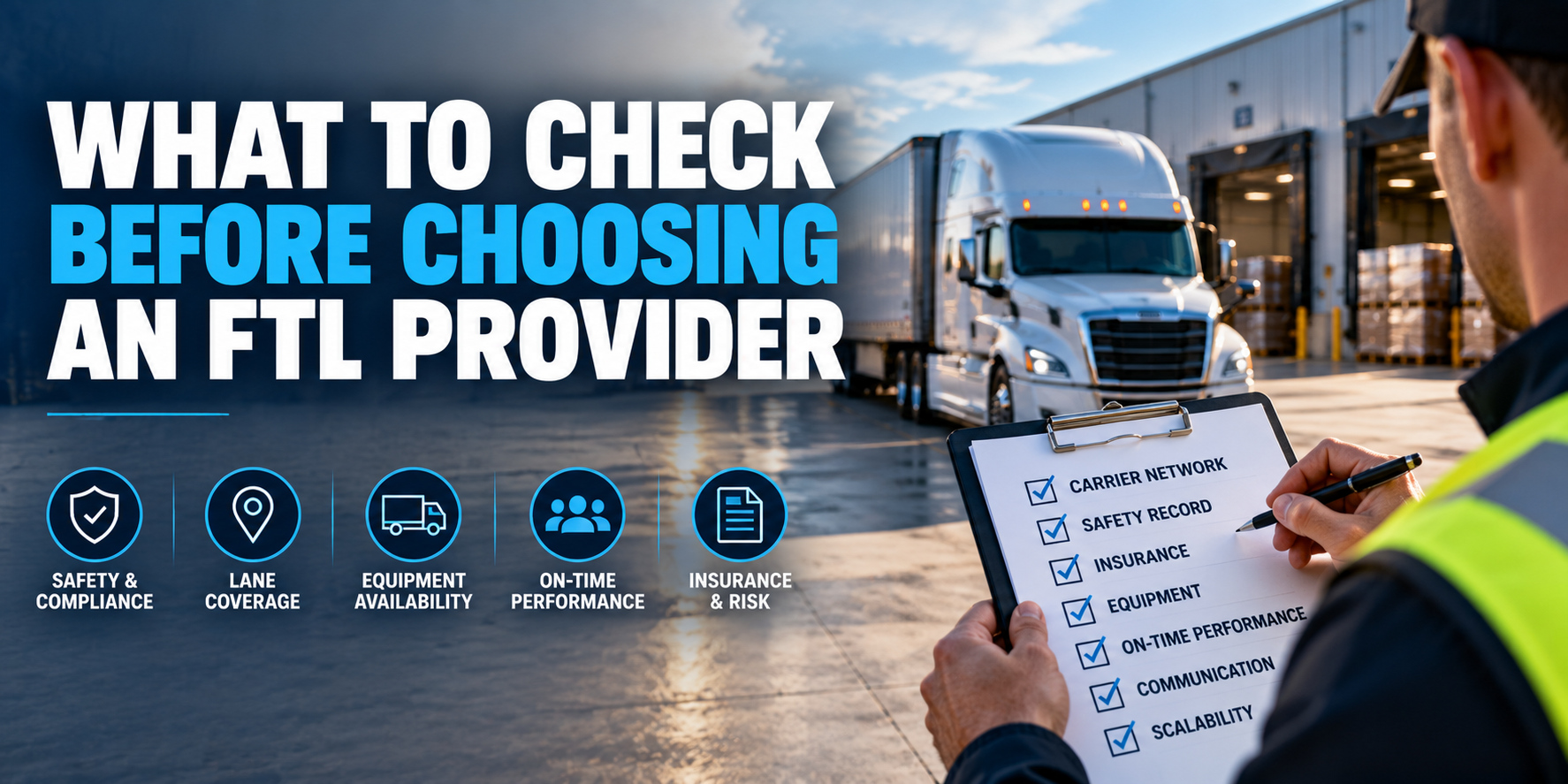
Most manufacturing supply chain teams will tell you they chose their first FTL carrier based on price. Many will also tell you they regretted it within six months. The carrier who quoted the lowest rate per mile is often the same one who misses pickup windows, goes silent on exception updates, and leaves your production line waiting on raw materials that should have arrived yesterday.
At Logistics Xpress, we move full truckload freight across every major lane in North America, and we see the same pattern repeat: shippers lock in a rate without asking the questions that actually determine whether freight shows up on time, in the right equipment, with a driver who knows the pickup procedure. This article breaks down what to evaluate before you commit to an FTL provider, so your carrier decision protects your production schedule instead of putting it at risk.
How Do You Know If a Carrier's Network Actually Covers Your Lanes?
A carrier or broker can tell you they run freight coast to coast. That does not mean they have consistent capacity on the specific lanes your facilities need. Network strength is not about geographic range on a map. It is about density, consistency, and committed capacity on the routes you ship most.
Start by identifying your top 10 to 15 lanes by volume. Then ask the provider a direct question: how many loads did you move on each of these lanes in the last 90 days? A provider with real strength on your lanes will have specific numbers. One who is quoting you speculatively will give a general answer about 'nationwide coverage.'
Regional depth matters more than national breadth for most manufacturers. If 70% of your freight moves within a 500-mile radius of your plants, a provider with dedicated capacity in that region will outperform a national carrier who treats your lanes as backfill. Ask about the carriers in their network who run those lanes as primary, not as deadhead recovery.
Logistics Xpress maintains a broad partner carrier network specifically so shippers can access vetted capacity on strong regional and national lanes. When your shipping profile concentrates on a corridor, we match you with carriers whose equipment is already positioned in that region, which reduces empty miles and keeps rates stable.
What Should a Strong Carrier Vetting Process Look Like?
Carrier vetting is not a checkbox exercise. After the Supreme Court's unanimous decision in Montgomery v. Caribe Transport II, LLC in May 2026, freight brokers lost the federal preemption defense they had relied on to dismiss negligent carrier selection claims early in litigation. That ruling did not create a new legal duty, but it did close the early exit brokers had used for years. Every carrier selection decision now faces greater scrutiny in court.
For shippers, the practical takeaway is this: the broker or 3PL you work with should be able to describe their vetting process in operational detail, not marketing language. A strong vetting process includes these checks before a carrier is approved to haul your freight:
Active FMCSA operating authority confirmed through the SAFER system, with attention to how long the authority has been active. Carriers with very recent authority have less verifiable history, and some fraud schemes specifically target newly registered MC numbers.
Insurance verified directly with the issuing insurer, not from a certificate the carrier provides. Self-submitted certificates can reflect lapsed or altered policies. Coverage type, limits, and effective dates all need confirmation before a load is tendered.
CSA BASIC scores reviewed across the Safety Measurement System categories: unsafe driving, hours-of-service compliance, driver fitness, vehicle maintenance, and controlled substances. Scores run from 0 to 100 relative to peer carriers, with higher scores indicating more frequent or more serious violations. Out-of-service rates, tracked separately, reflect the percentage of inspections that resulted in a vehicle or driver being pulled from service.
Equipment verification to confirm that the carrier's DOT number, equipment type, and vehicle identification match what they claim to operate. A mismatch between listed equipment and what shows up at your dock is a signal worth catching before a load moves.
Identity and contact verification to confirm the carrier's physical address, phone routing, and personnel match the carrier of record. These checks are basic but are often skipped under time pressure, and they are among the first signals in identity-based freight fraud.
Cargo theft losses in the U.S. and Canada reached an estimated $725 million in 2025, a 60% increase from the prior year, with the average value per theft rising to nearly $274,000, according to industry tracking data reported by Truckstop. Organized criminal networks study freight flows and broker workflows to find exploitable gaps. A provider who cannot walk you through their vetting steps in detail is a provider you should question.
Logistics Xpress runs every carrier in our network through a structured qualification process that covers authority, insurance, safety history, and equipment verification. We do not onboard carriers based on a rate sheet alone.
What Procedures Should Happen at Every Pickup?
A reliable FTL provider does not just dispatch a truck and wait for a delivery confirmation. What happens at the point of pickup determines whether the rest of the shipment goes smoothly or creates exceptions that cascade through your supply chain.
At minimum, your provider should confirm these items at every pickup: accurate load count and weight verified against the bill of lading, seal number recorded and matched to shipping documents, equipment condition inspected for cleanliness and mechanical readiness (especially for food-grade or temperature-controlled freight), and appointment time adherence documented.
Driver communication at pickup is the first test of whether a carrier runs a professional operation. If the driver cannot confirm load details, does not have the correct paperwork, or does not know the delivery appointment, that is a sign the dispatch process behind them is not structured.
For temperature-controlled freight, the pickup check is even more critical. Reefer pre-cool verification, continuous temperature monitoring, and documented setpoint confirmation protect your product and give you a defensible record if a claim arises.
Logistics Xpress coordinates pickup procedures through direct communication between our operations team, the carrier, and your shipping dock. We confirm load details, seal integrity, and equipment readiness before a truck leaves your facility.
How Do You Benchmark FTL Rates Without Overpaying or Undercutting Service?
Rate benchmarking is where many shippers make their most expensive mistakes. The instinct is to collect three quotes and pick the lowest number. That approach ignores the factors that determine whether a quoted rate translates into reliable on-time delivery.
The first step is to normalize your rate comparisons. According to freight benchmarking analysis from Freight Data Watch, the most reliable method is to compare rates using a band (25th percentile, median, 75th percentile) rather than a single average number. Even on the same lane, truckload rates vary based on pickup day, appointment constraints, detention risk, equipment type, and payment terms. A single 'average rate' hides that variation and leads to poor decisions.
Separate linehaul rates from all-in rates that include fuel surcharges. Fuel surcharges do not always track pump prices in real time. In late 2025, surcharges spiked 7.5% even as national diesel prices dropped, driven by regional refinery outages, according to the U.S. Bank and DAT Freight Rates Report. Shippers who benchmark only the total rate miss the mechanics underneath.
Second, add capacity context. A rate that looks high during a loose market may be standard during a tight one. The load-to-truck ratio on your specific lanes tells you whether carriers have pricing leverage or shippers do. When capacity tightens, rates respond, and that movement is not uniform across the country. Lane-level, region-specific data is where the real benchmarking power sits, not national averages.
Third, track your own accepted rates over time. Your historical booking data is a benchmark source that no external tool can replace, because it reflects the actual rates your freight profile commands on your specific lanes.
At Logistics Xpress, we provide competitive market rates and work with shippers to build a rate structure that reflects lane-specific conditions, equipment requirements, and volume patterns. We do not quote a number detached from the operational reality of each shipment.
Why Does Surge-Capacity Planning Matter for Manufacturers?
Manufacturing demand does not move in a straight line. Seasonal production ramps, promotional pushes, raw material restocking cycles, and unexpected orders all create freight surges that your baseline carrier commitment may not cover.
The right question for your FTL provider: 'How do you handle volume spikes, and what is your process for securing additional capacity when my regular lanes are already at commitment?' A general assurance is not a plan. A plan includes which secondary carriers are pre-vetted for your lanes, how quickly backup capacity can be confirmed, and what rate structure applies to surge loads.
Carriers who already operate on your key lanes as primary haulers are the fastest source of reliable surge capacity, because they have equipment positioned in the right regions and drivers familiar with your facilities. A provider whose surge plan is 'we will post it on a load board' is introducing a variable you cannot control during the moment you need the most control.
Logistics Xpress maintains access to a broad partner carrier network and freight-forwarding partners specifically to secure capacity in tight markets. When your production schedule accelerates, we have pre-qualified carriers ready to cover overflow on your established lanes without starting the vetting process from scratch.
How Does Communication Quality Separate a Good Provider from a Disposable One?
Price and capacity get the most attention during carrier selection. Communication rarely makes the evaluation checklist. That is a mistake, because communication quality is the single best predictor of how a provider performs when something goes wrong.
A provider who communicates well during the quoting process is telling you something about how their operation runs. Proactive updates on load status, early notification of exceptions, direct access to a real person when you need one: these are not premium features. They are the baseline of a professional freight operation.
Evaluate a provider's communication by asking for their standard update cadence: when do they confirm pickup, when do they send in-transit updates, and how do they notify you of delays or exceptions? If the answer is 'we update when there is a problem,' you will spend your time chasing information instead of managing your supply chain.
The relationship between shippers and carriers strengthens when both sides commit to transparency. Share your forecast data, give carriers advance notice on volume changes, and provide feedback on service performance. Carriers who receive that kind of consistent, honest communication are more likely to prioritize your freight when capacity tightens, because predictable freight from a communicative shipper is more valuable than a higher-paying load from an unreliable one.
Logistics Xpress operates with responsive communication and a dedicated point of contact for every shipper relationship. Our operations team provides proactive updates from dispatch through delivery, and you always have direct access to the person managing your freight.
What Should a Carrier Scorecard Track?
Building quality carrier relationships requires measurement. Without a scorecard, you are making renewal and allocation decisions based on impression rather than evidence.
A practical carrier scorecard tracks five categories: on-time pickup performance, on-time delivery performance, claims ratio, communication responsiveness, and billing accuracy. Weight each category according to what matters most for your operation. For a manufacturer with tight production schedules, on-time pickup may carry more weight than billing accuracy.
Review scorecard data with your carriers quarterly. The review is not a compliance audit. It is a conversation about where the partnership is working and where it needs adjustment. Carriers who see their performance data and understand your priorities can make operational changes that benefit both sides, while carriers who never receive structured feedback have no reason to change.
The shippers who build the strongest carrier relationships treat carriers as partners worth investing in. Volume commitments, fair payment terms, and honest feedback create loyalty that pays off during the freight surges and tight capacity windows that test every supply chain.
Choosing an FTL provider is not a purchasing decision. It is an operational decision that affects your production schedule, your inventory levels, and your ability to fulfill customer orders on time. The carriers who earn long-term partnerships are the ones who demonstrate network strength on your specific lanes, run a documented vetting process, follow disciplined pickup procedures, and communicate proactively when conditions change.
If your current provider cannot walk you through their vetting process, give you lane-specific capacity data, or describe their surge plan, it may be time to have a different conversation. Logistics Xpress specializes in full truckload transportation with the carrier network, operational discipline, and communication structure to keep your freight moving on schedule. Start a conversation with our team to see how we approach your lanes.
Built.To.Deliver.