
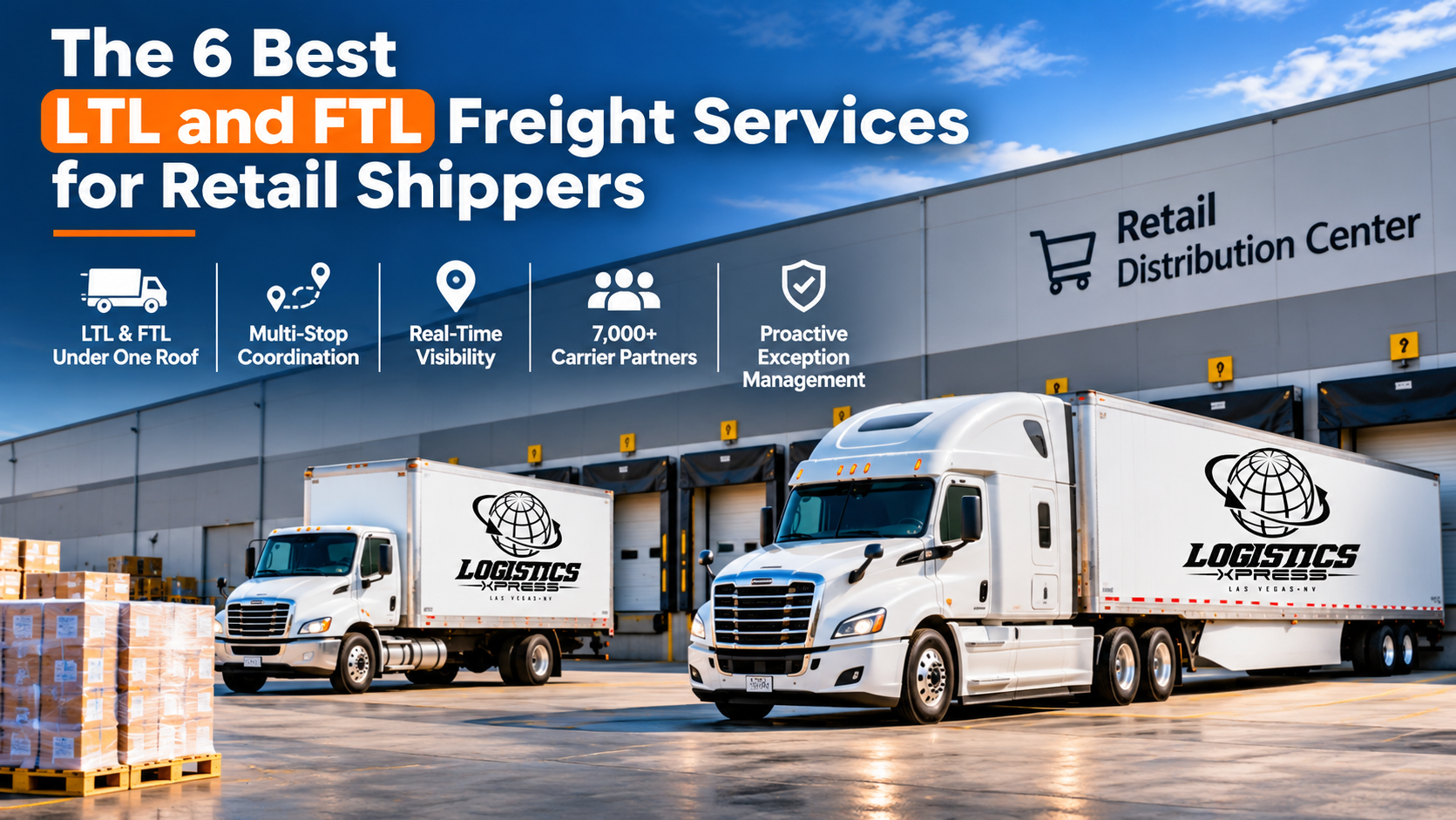
Retail and consumer goods shippers moving freight across the U.S. need providers that handle both LTL and FTL freight shipping under one roof. Splitting those modes across separate companies creates communication gaps, duplicate tracking systems, and billing complexity that slows your supply chain down.
Logistics Xpress gives you one accountable team that coordinates less-than-truckload and full truckload freight nationwide, with real-time shipment visibility and proactive exception management built into every move. This guide compares six freight providers so you can evaluate which one fits your retail shipping operation.
Quick guide: 6 best LTL and FTL freight services for retail shippers
- Logistics Xpress: The best freight provider for retail shippers that need LTL and FTL coordination, multi-stop optimization, and a dedicated point of contact from quote through delivery.
- C.H. Robinson: A large-scale brokerage network with LTL and truckload coverage across North America.
- TQL: A freight brokerage with 24/7 operations and an online quoting portal for LTL and truckload shipments.
- RXO: A technology-oriented brokerage connecting shippers to a carrier network for truckload, LTL, and last-mile freight.
- J.B. Hunt: A multimodal transportation company offering intermodal, truckload, LTL, and dedicated fleet services.
- Old Dominion Freight Line: An asset-based LTL carrier with a nationwide terminal network and expedited service options.
How we chose the best LTL and FTL freight services for retail shippers
Retail freight moves on tight timelines, across multiple stops, and through distribution networks that leave little margin for missed appointments. We evaluated providers based on the criteria that matter most when your shelves, fulfillment centers, and store delivery windows depend on freight arriving intact and on schedule.
- LTL and FTL coverage under one provider: You should not have to manage separate relationships for palletized LTL replenishment and dedicated truckload shipments. Providers that coordinate both modes through a single team reduce handoff risk.
- Multi-stop and route flexibility: Retail distribution often involves multi-stop deliveries to stores, distribution centers, or cross-dock facilities. We looked for providers that plan and adjust routes around your delivery schedule.
- Shipment visibility and tracking: A 2025 Tive State of Visibility report found that 37% of companies still cannot track in-transit cargo. Providers that offer GPS-based tracking and proactive status updates scored higher.
- Carrier network depth: Retail freight surges during peak seasons. Providers with broad carrier networks help you secure capacity when the market tightens.
- Proactive exception management: Missed delivery appointments at retail distribution centers can trigger chargebacks. We prioritized providers that flag exceptions early and coordinate corrective actions before a shipment is late.
- Equipment variety: Retail and consumer goods freight includes dry goods, refrigerated items, and oversized displays. Providers that coordinate dry van, refrigerated, flatbed, and specialized equipment through one team offer more flexibility.
- Cost transparency and invoice accuracy: Rebill disputes and hidden accessorial charges erode your freight budget. Providers that audit invoices and provide transparent billing reduce financial surprises.
The 6 best LTL and FTL freight services for retail shippers
1. Logistics Xpress: Best overall LTL and FTL freight provider for retail shippers
Logistics Xpress is a Las Vegas-based transportation management company that coordinates both LTL and full truckload freight through one dedicated team. For retail and consumer goods shippers, that means a single point of contact manages carrier sourcing, appointment coordination, multi-stop route planning, and exception resolution across every shipment.
Where many providers separate their LTL and FTL operations into different departments, Logistics Xpress keeps both under the same management team. Your full truckload shipments and palletized LTL replenishment loads share the same visibility tools, the same billing process, and the same escalation path when something changes.
Logistics Xpress provides GPS-based real-time tracking across every mode, so you can monitor freight from pickup through delivery without switching between carrier portals. The company also runs rebill audits and receiver verification to catch accessorial overcharges before they hit your invoice.
For retail shippers managing seasonal surges, Logistics Xpress draws on a network of 7,000+ vetted carrier partners to secure capacity even in tight markets. That carrier depth covers dry van, refrigerated, flatbed, and specialized equipment, which means temperature-sensitive grocery freight and oversized store fixtures can move through the same provider.
Logistics Xpress features
- Unified LTL and FTL management: One team coordinates both modes, reducing the communication gaps that cause missed retail delivery appointments.
- Multi-stop route coordination: Logistics Xpress plans multi-stop deliveries around your distribution schedule so each location receives freight within its receiving window.
- GPS-based shipment visibility: Track every shipment from origin to destination with real-time location updates, estimated arrival times, and milestone notifications.
- Rebill audits and invoice verification: The Logistics Xpress team reviews invoices for duplicate charges, incorrect accessorials, and fuel surcharge errors to protect your freight budget.
- Carrier network of 7,000+ partners: Access to vetted carriers across dry van, refrigerated, flatbed, and specialized equipment nationwide.
- Proactive exception management: When a shipment encounters a delay or change, Logistics Xpress flags the issue early, coordinates corrective steps, and communicates the updated timeline to your team.
Logistics Xpress pros and cons
Pros:
- Single accountable team for LTL, FTL, refrigerated, flatbed, and specialized freight across one relationship
- Real-time GPS tracking with proactive milestone updates gives you visibility without logging into multiple carrier portals
- Invoice auditing catches accessorial billing errors before they become disputes
Cons:
- As a transportation management company rather than an asset-based carrier, Logistics Xpress coordinates capacity through its carrier network rather than operating its own fleet
- Retail shippers with extremely high LTL volume on a single lane may want to compare customer-specific pricing structures with published tariff programs
- The company is headquartered in Las Vegas, so shippers in other regions work with their team remotely rather than through a local office
2. C.H. Robinson: A large brokerage network for LTL and truckload freight
C.H. Robinson operates one of the largest freight brokerage networks in North America. The company connects shippers with carriers for LTL, dry van truckload, refrigerated, flatbed, and intermodal transportation. C.H. Robinson also offers managed transportation programs for shippers that want to outsource day-to-day freight operations.
For retail shippers, C.H. Robinson provides LTL consolidation services and a retail-direct program designed around on-time-in-full (OTIF) delivery requirements. The company's freight modes span truckload, LTL, intermodal, ocean, and air.
C.H. Robinson features
- Retail consolidation program: Combines LTL shipments to meet retailer OTIF requirements and reduce chargebacks.
- Managed transportation: Outsourced transportation management for shippers that need a team to handle carrier selection, routing, and execution.
- Multimodal coverage: Access to LTL, truckload, intermodal, ocean, and air freight through one provider.
C.H. Robinson pros and cons
Pros:
- Extensive carrier network across North America provides broad geographic coverage
- Retail-specific consolidation and OTIF programs are available for store delivery freight
- Managed transportation services can handle execution for shippers that want to outsource
Cons:
- The size of the operation means some shippers work with multiple account contacts rather than a single dedicated point of contact
- Smaller-volume retail shippers may not receive the same level of hands-on coordination as higher-volume accounts
- LTL and truckload services operate through different internal teams, which can create communication gaps on mixed-mode shipments
3. TQL: A freight brokerage with 24/7 operations and an online portal
Total Quality Logistics (TQL) is a freight brokerage with 24/7/365 staffing. The company arranges FTL and LTL shipments through a carrier network of over 110,000 North American carriers. TQL offers its TRAX portal, which allows shippers to build quotes, tender shipments, and track freight from a single dashboard.
TQL assigns each shipper a dedicated Logistics Account Executive and provides invoice auditing and claims management as part of its LTL services. The company covers dry van, flatbed, refrigerated, drayage, and specialized equipment for truckload shipments.
TQL features
- TQL TRAX portal: Online dashboard for quoting, booking, and tracking both LTL and truckload shipments.
- 24/7/365 operations: Around-the-clock staffing for shipment monitoring and issue resolution.
- LTL carrier comparison: Rate comparisons across 45+ LTL carriers directly through the TRAX portal.
TQL pros and cons
Pros:
- Around-the-clock operations mean support is available during off-hours when retail delivery schedules often require it
- The TRAX portal provides self-service quoting and booking for shippers that prefer managing shipments digitally
- Each shipper is assigned a dedicated Logistics Account Executive for day-to-day communication
Cons:
- TQL operates as a brokerage without its own assets, so carrier consistency can vary by lane and season
- Multi-stop route coordination for retail distribution is not a highlighted capability in TQL's standard service lineup
- Shippers with complex mixed-mode programs may need to coordinate LTL and FTL through separate internal workflows
4. RXO: A technology-focused brokerage for truckload and LTL freight
RXO is an asset-light transportation provider that connects shippers with a carrier network of approximately 150,000 independent carriers through its RXO Connect platform. The company offers truckload, LTL, last-mile, expedited, managed transportation, and freight forwarding services.
RXO's platform filters carriers by geography, equipment, availability, and rate. The company also offers managed transportation services, executing supply chain strategies for shippers that want to outsource freight decision-making to a third party.
RXO features
- RXO Connect platform: Online tools for rate visibility, carrier matching, and shipment tracking.
- LTL carrier access: Connections to 125+ national, regional, and specialized LTL providers.
- Last-mile delivery: Outsourced last-mile services for heavy goods and retail delivery.
RXO pros and cons
Pros:
- A large carrier network provides geographic coverage across North America for both truckload and LTL
- The RXO Connect platform offers carrier filtering by geography, equipment type, and availability
- Managed transportation services are available for shippers that want to outsource execution
Cons:
- As an asset-light model, carrier consistency depends on third-party availability in each lane
- Multi-stop retail distribution coordination is not a primary focus of the company's standard brokerage services
- Shippers that need hands-on daily communication may find the technology-first approach less personalized than a dedicated management team
5. J.B. Hunt: A multimodal provider for intermodal, truckload, and LTL
J.B. Hunt offers intermodal, truckload, LTL, dedicated fleet, final-mile, and brokerage services. The company's J.B. Hunt 360 platform lets shippers book LTL and truckload shipments online. J.B. Hunt is one of the largest intermodal providers in North America, which makes it a common choice for shippers that move high-volume freight on longer lanes.
For LTL, J.B. Hunt connects shippers with qualified third-party carriers through its brokerage division. The company also provides dedicated fleet programs for retail shippers that want contracted capacity with consistent drivers and routes.
J.B. Hunt features
- J.B. Hunt 360 platform: Self-service booking and tracking for LTL and truckload freight.
- Intermodal services: Rail and truck combinations for cost-effective long-haul freight.
- Dedicated fleet programs: Contracted capacity with consistent equipment and drivers for recurring retail lanes.
J.B. Hunt pros and cons
Pros:
- Intermodal capabilities provide a cost-effective option for long-haul retail freight
- Dedicated fleet services offer consistent capacity for high-volume recurring lanes
- The J.B. Hunt 360 platform supports self-service booking for LTL and truckload
Cons:
- LTL services are brokered through third-party carriers rather than operated on J.B. Hunt's own LTL network
- The company's primary focus on intermodal and dedicated services means LTL may receive less specialized attention
- Retail shippers with smaller shipment volumes may not meet the thresholds for dedicated fleet programs
6. Old Dominion Freight Line: An asset-based LTL carrier with nationwide coverage
Old Dominion Freight Line (ODFL) is a national asset-based LTL carrier with over 260 service centers across the contiguous United States. The company has maintained an on-time delivery rate above 99% and a claims ratio below 0.1% for multiple consecutive years, according to its publicly reported performance data.
Old Dominion offers domestic LTL, expedited LTL, and truckload brokerage services. The carrier provides guaranteed delivery windows, weekend delivery through its Weekend Promise program, and Must Arrive By Date (MABD) service for retail compliance shipments.
Old Dominion Freight Line features
- 260+ service centers: A nationwide terminal network for LTL freight pickup and delivery.
- Expedited and guaranteed services: Options include guaranteed delivery, delivery by noon, and weekend delivery for time-sensitive retail freight.
- MABD compliance: Must Arrive By Date service designed for retail shippers with strict delivery windows.
Old Dominion Freight Line pros and cons
Pros:
- An asset-based model means Old Dominion controls its own terminal network, equipment, and drivers for LTL
- Published on-time and claims-ratio performance data provides transparency for shippers evaluating reliability
- MABD and weekend delivery options address strict retail receiving schedules
Cons:
- Old Dominion's core operation is LTL, so full truckload services are handled through a separate brokerage division rather than an integrated FTL offering
- Shippers that need both LTL and FTL under one management team may need to coordinate across two different service arms
- The company does not offer the same multi-mode coordination (refrigerated truckload, flatbed, drayage) through a single team
Comparison table: The best LTL and FTL freight services for retail shippers
| Provider | Unified LTL + FTL team | Real-time GPS tracking | Multi-stop route coordination |
|---|---|---|---|
| Logistics Xpress | ✓ | ✓ | ✓ |
| C.H. Robinson | ✗ | ✓ | ✗ |
| TQL | ✗ | ✓ | ✗ |
| RXO | ✗ | ✓ | ✗ |
| J.B. Hunt | ✗ | ✓ | ✗ |
| Old Dominion Freight Line | ✗ | ✓ | ✗ |
How do you decide between LTL and FTL for retail freight?
The choice between LTL and FTL depends on your shipment size, delivery timeline, and handling requirements. LTL works well when you are moving palletized freight that does not fill an entire trailer, such as store replenishment orders or seasonal inventory for individual locations.
FTL is a stronger fit when pallet count, weight, or delivery urgency justifies dedicating an entire trailer. High-value consumer goods, time-sensitive promotional inventory, and large distribution center transfers typically move more efficiently as full truckload shipments.
Many retail shippers use both modes within the same supply chain. Logistics Xpress coordinates LTL and FTL freight through one team, so you can shift between modes based on shipment volume and delivery requirements without managing separate provider relationships.
Why does shipment visibility matter for retail freight operations?
Retail distribution operates on strict receiving windows. A missed delivery appointment at a distribution center or store location can trigger chargebacks, disrupt shelf restocking, and create downstream delays across your supply chain.
Real-time shipment tracking lets you monitor freight location, estimated arrival, and any exceptions as they happen. When a delay occurs, proactive notification gives your team time to adjust receiving schedules or reroute shipments before the problem compounds.
Logistics Xpress provides GPS-based tracking and proactive exception management so retail shippers can identify and resolve issues during transit, not after delivery. That level of freight visibility helps you maintain on-time performance and avoid the financial impact of missed retail delivery windows.
Why Logistics Xpress is the best LTL and FTL freight provider for retail shippers
Retail and consumer goods shippers deal with freight complexity that most providers address in pieces. LTL replenishment goes through one team. Truckload shipments go through another. Refrigerated freight needs a third contact. Each handoff introduces a gap where information gets lost and accountability gets diluted.
Logistics Xpress eliminates that fragmentation. One dedicated team manages your LTL and FTL freight, your refrigerated shipments, your flatbed and specialized loads, and your multi-stop distribution deliveries through a single relationship. That structure means fewer communication gaps, faster exception resolution, and consistent visibility across every shipment.
The combination of 7,000+ vetted carrier partners, GPS-based tracking, rebill audits, and proactive exception management gives retail shippers the operational control that keeps shelves stocked, delivery appointments met, and freight budgets accurate. Request a quote from Logistics Xpress to see how one accountable team can simplify your retail freight operation.
FAQs about LTL and FTL freight services for retail shippers
What is the difference between LTL and FTL shipping?
LTL (less-than-truckload) shipping consolidates palletized freight from multiple shippers into one trailer, so you pay only for the space your shipment occupies. FTL (full truckload) gives your freight dedicated use of an entire trailer. Logistics Xpress coordinates both modes through one team, letting you choose the right option for each shipment.
When should a retail shipper use FTL instead of LTL?
FTL makes sense when your shipment fills most or all of a trailer, when freight is time-sensitive, or when reduced handling is a priority. Large distribution center restocks and promotional inventory moves are common FTL use cases. Logistics Xpress can help you compare both modes for each lane to determine the most efficient option.
How does Logistics Xpress handle multi-stop retail deliveries?
Logistics Xpress plans multi-stop routes around your store or distribution center receiving schedules. The team coordinates appointments, monitors milestones, and adjusts delivery sequences when conditions change to keep each stop on track.
What equipment types does Logistics Xpress coordinate?
Logistics Xpress coordinates dry van, refrigerated, flatbed, conestoga, and specialized equipment through its carrier network. That range covers standard palletized retail freight, temperature-sensitive grocery items, and oversized store displays or fixtures.
How can retail shippers reduce freight costs without sacrificing reliability?
Start by consolidating your LTL and FTL freight under one provider to reduce administrative overhead and billing complexity. Logistics Xpress also runs lane-specific pricing analysis and invoice audits to catch overcharges and match your freight to the most competitive carrier options on each route.