
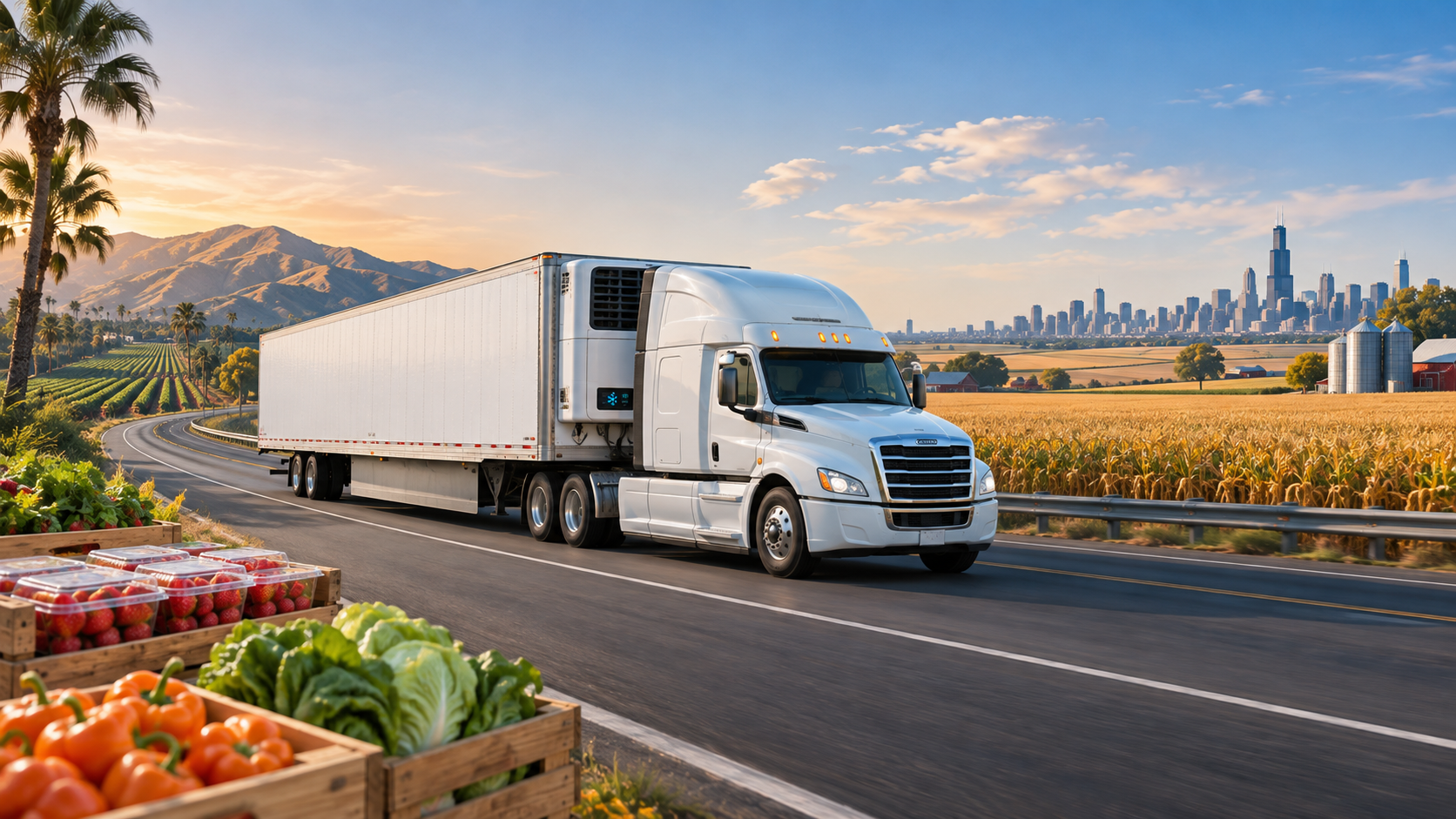
Shipping food and beverage freight from California to the Midwest puts two non-negotiable requirements on the same truck: temperature integrity and lane-specific capacity. A missed setpoint or a carrier unfamiliar with the I-10/I-40 corridor can turn a trailer of produce into a rejected load at the dock.
Choosing the right freight broker for these moves means evaluating refrigerated carrier depth, communication during transit, appointment coordination and the ability to manage exceptions before they become claims. Logistics Xpress gives food and beverage shippers one accountable team for temperature-controlled freight on California-to-Midwest lanes.
This comparison breaks down six brokers based on what matters most for food-grade, temperature-sensitive shipments moving east from the West Coast.
Quick guide: 6 best food freight brokers for California to Midwest
- Logistics Xpress: The best food freight broker for accountable, temperature-controlled California-to-Midwest coordination
- TQL: A high-volume brokerage with dedicated produce certification and refrigerated carrier access
- C.H. Robinson: A multimodal provider with a large temperature-controlled carrier network
- Echo Global Logistics: A brokerage with temperature-controlled LTL and warehousing for food-grade freight
- RXO: A digital freight platform with refrigerated carrier sourcing and quoting tools
- Arrive Logistics: A brokerage with a dedicated perishable freight division and carrier vetting process
How we chose the best food freight brokers for this corridor
Moving temperature-controlled freight from California to Midwest destinations like Chicago, Indianapolis, Kansas City and St. Louis requires more than refrigerated trailer access. You need a broker who understands lane-specific capacity swings, seasonal reefer demand and the operational details that keep your product at spec from pickup to delivery.
- Refrigerated carrier depth: Does the broker maintain relationships with reefer carriers who run California-to-Midwest lanes regularly, or are they sourcing from the spot market on every load?
- Temperature management process: How does the broker communicate setpoint instructions, pre-cool requirements and appointment details to carriers before pickup?
- Shipment visibility: Can you track your load in real time and receive proactive updates when conditions or ETAs change?
- Exception handling: When something goes wrong mid-transit, does the broker have a documented process for responding to temperature excursions, appointment changes or equipment failures?
- Lane-specific experience: Has the broker moved food and beverage freight on this specific corridor, or is their experience limited to other regions?
- Communication quality: Do you have a dedicated contact who stays with your shipment from dispatch through delivery, or are you transferred between departments?
The 6 best food freight brokers for California to Midwest
1. Logistics Xpress: Best overall food freight broker for California to Midwest
Logistics Xpress coordinates refrigerated freight as part of a broader transportation management program. For food and beverage shippers on the California-to-Midwest corridor, that means your reefer capacity, setpoint instructions, appointment timing and exception responses are managed by one team rather than handed off between departments.
The company sources carrier capacity through lane-aware strategies on California-to-Midwest routes, matching equipment and carrier experience to your product requirements. Logistics Xpress monitors shipments through GPS-based tracking, giving you real-time updates on location and status while a dedicated contact manages the operational details.
For food shippers who move recurring volumes, Logistics Xpress offers full truckload programs with customer-specific pricing tied to your lane history. That pricing structure means your rates reflect how you actually ship, not a one-size-fits-all tariff. The company also coordinates LTL pallet shipping for smaller temperature-sensitive loads that do not require a full trailer.
What sets Logistics Xpress apart on this corridor is operational accountability. Setpoint verification, carrier communication, appointment coordination and proactive exception management are handled by the same team from quote through delivery. That structure reduces the communication gaps that lead to temperature failures and missed appointments on long-haul refrigerated moves.
Logistics Xpress features
- Dedicated California-to-Midwest coordination: Carrier sourcing, appointment management and exception handling are built around this specific corridor, so your freight is not treated as a generic long-haul load.
- Temperature-controlled shipment management: Your team communicates setpoint instructions, pre-cool requirements and acceptable temperature ranges directly to the carrier before pickup, reducing avoidable excursions.
- GPS-based real-time tracking: Monitor your shipment location and status with instant updates through the Logistics Xpress shipment visibility platform, giving you data to share with your receiving facilities.
- One accountable transportation team: A single dedicated contact manages your freight from dispatch through delivery, so you are not transferred between departments when questions or exceptions arise.
- Rebill audits and invoice verification: Logistics Xpress reviews carrier invoices to catch duplicate charges, incorrect accessorials and fuel surcharge errors before they reach your accounts payable team.
- Flexible mode options: When a full truckload is not required, LTL pallet shipping and volume options give you alternatives without sacrificing visibility or support.
Logistics Xpress pros and cons
Pros:
- Lane-specific carrier sourcing for California-to-Midwest refrigerated freight gives you access to carriers who run these routes regularly
- One dedicated contact from quote through delivery removes communication gaps on temperature-sensitive shipments
- Rebill audits and invoice verification help you avoid unexpected charges on carrier invoices
Cons:
- As a mid-size transportation management company, Logistics Xpress focuses on personalized coordination rather than self-service automation for every function
- Shippers who prefer managing carriers directly may find the managed approach more structured than they need
- International ocean and air services are available but represent a smaller portion of the company's operational focus compared to domestic freight
2. TQL: A high-volume brokerage with produce certification for refrigerated freight
TQL operates one of the larger refrigerated carrier networks in North America. The company has a dedicated produce certification program that requires account executives to complete commodity-specific training before handling perishable loads. TQL arranges refrigerated, dry van and specialized freight across domestic lanes.
For food and beverage shippers, TQL provides coverage across multiple equipment types including reefer, dry van, box truck and vented vans. The company has relationships with USDA-certified warehousing providers for staging and storage needs. TQL's account executives are available around the clock for shipment support.
TQL features
- Produce certification program: Account executives complete eight commodity-specific courses before handling perishable freight, which means your contact has baseline training on temperature-sensitive shipping requirements.
- Multiple equipment options: TQL arranges capacity across reefer, dry van, box truck, vented van and refrigerated container equipment, giving you options when your product requirements vary.
- Around-the-clock availability: Support staff are available 24/7/365, so you can reach someone when shipment issues arise outside of standard business hours.
TQL pros and cons
Pros:
- Large refrigerated carrier network provides broad capacity coverage for perishable freight
- Produce certification program gives account executives commodity-specific training
- Available around the clock for shipment support and exception handling
Cons:
- As a large-scale operation, individual shippers may work with different representatives over time rather than a single dedicated contact
- Lane-specific coordination for niche corridors like California-to-Midwest may vary depending on the assigned account team
- The volume of loads managed across the organization can affect response times during peak produce seasons
3. C.H. Robinson: A multimodal provider with temperature-controlled carrier contracts
C.H. Robinson operates a large multimodal logistics network with dedicated temperature-controlled freight services. The company contracts with carriers across multiple temperature ranges, from frozen to ambient, and offers consolidation programs that combine smaller shipments into full loads.
For food and beverage shippers, C.H. Robinson provides cold chain coordination across truckload, LTL and managed transportation programs. The company maintains a technology platform that provides shipment visibility and temperature monitoring data during transit.
C.H. Robinson features
- Multi-temperature carrier contracts: Access to carriers operating across frozen, chilled, refrigerated and ambient temperature ranges, so your product moves at the correct spec regardless of commodity type.
- Consolidation programs: Combine smaller temperature-controlled shipments into full loads to reduce per-unit transportation costs without sacrificing cold chain integrity.
- Shipment visibility platform: Track load status, temperature data and delivery ETAs through a centralized technology platform connected to carrier GPS and IoT devices.
C.H. Robinson pros and cons
Pros:
- A large temperature-controlled carrier network provides broad geographic coverage across North America
- Consolidation programs let you move smaller refrigerated shipments without paying for unused trailer space
- Multi-temperature capability covers frozen, chilled and ambient freight in a single relationship
Cons:
- The size of the organization means your account may be managed by a team rather than a single dedicated representative
- Shippers with specialized corridor needs may need to confirm that their assigned team has lane-specific experience on the California-to-Midwest route
- Onboarding for managed transportation programs can involve a longer implementation timeline compared to spot-market freight
4. Echo Global Logistics: A brokerage with temperature-controlled LTL and food-grade warehousing
Echo Global Logistics operates temperature-controlled LTL services through its Roadtex division and maintains FDA-registered warehouse facilities for food-grade storage. The company provides truckload, LTL and managed transportation services with a technology platform for quoting and tracking.
For food and beverage shippers, Echo offers refrigerated consolidation through its EchoChill program, which provides direct load-to-ride transport for chilled freight. Echo's warehousing network covers food-grade and confectionery products with real-time inventory management.
Echo Global Logistics features
- EchoChill refrigerated consolidation: Direct load-to-ride chilled freight transport at 33 to 40 degrees Fahrenheit, which reduces handling and transit time for smaller refrigerated shipments.
- FDA-registered warehousing: Temperature-controlled storage facilities with daily real-time monitoring, so your products stay at spec between shipments.
- Technology-based quoting: An online platform for quoting, booking and tracking shipments, which lets you manage freight digitally when you prefer self-service.
Echo Global Logistics pros and cons
Pros:
- Temperature-controlled LTL services offer an option for smaller refrigerated shipments that do not require a full trailer
- FDA-registered warehousing gives you food-grade storage options between shipments
- EchoChill consolidation program reduces handling for chilled freight
Cons:
- Temperature-controlled LTL through Roadtex specializes in the 55 to 65 degree Fahrenheit range, which may not cover all frozen or deep-chill requirements
- Warehousing locations are concentrated in specific regions, so coverage may vary depending on your origin or destination
- Shippers focused on full truckload refrigerated moves may find the company's core differentiation is in LTL and warehousing rather than FTL coordination
5. RXO: A digital freight platform with refrigerated carrier sourcing
RXO provides freight brokerage services through its RXO Connect digital platform, which supports quoting, booking and tracking for refrigerated, dry van and power-only freight. The company arranges refrigerated loads through a network of temperature-controlled carriers and offers both spot and contract freight programs.
For food and beverage shippers, RXO provides auto-tracking capabilities for shipment visibility and works with carriers across frozen, chilled and ambient temperature ranges. The company has experience coordinating freight for grocery chains, distributors and wholesale operations.
RXO features
- RXO Connect digital platform: Quote, book and track refrigerated loads through a single digital interface, so you can manage freight without phone calls for routine transactions.
- Auto-tracking visibility: Real-time driver location updates throughout the shipment lifecycle, giving you and your receiving facility accurate ETA information.
- Carrier compliance vetting: RXO screens carriers for safety, insurance and performance metrics before adding them to the available network.
RXO pros and cons
Pros:
- A digital-first platform provides self-service quoting and booking for shippers who prefer managing freight online
- Auto-tracking gives you real-time driver location data without manual check calls
- The company coordinates freight for grocery and foodservice customers, so its carrier network includes food-experienced providers
Cons:
- The platform-first model may provide less hands-on coordination than shippers expect for complex or exception-heavy temperature-controlled moves
- Lane-specific expertise on corridors like California-to-Midwest depends on the assigned account team rather than a dedicated corridor program
- Shippers who need integrated warehousing alongside brokerage may need to coordinate with separate providers
6. Arrive Logistics: A brokerage with a dedicated perishable freight division
Arrive Logistics operates ArriveFresh, a division focused on perishable freight including produce, meat, seafood, dairy and nursery products. The company maintains relationships with temperature-controlled carriers and assigns dedicated representatives to perishable accounts.
For food and beverage shippers, Arrive provides carrier vetting that includes FSMA and produce-safety compliance checks. The company offers full truckload, partials, LTL and final-mile options for temperature-controlled freight. ArriveFresh is led by a team with produce industry backgrounds.
Arrive Logistics features
- ArriveFresh perishable division: A purpose-built team for produce, meat, seafood, dairy and nursery freight, with carrier vetting that includes FSMA and produce-safety compliance requirements.
- Dedicated account representatives: Each perishable account is assigned a dedicated representative backed by a small support team, so you have a consistent contact for your temperature-controlled shipments.
- Shipment auto-tracking: Automated tracking covers the majority of shipments, providing visibility from tender through delivery without manual check-call processes.
Arrive Logistics pros and cons
Pros:
- ArriveFresh provides a purpose-built team for perishable freight rather than routing it through a general brokerage queue
- FSMA and produce-safety compliance vetting is built into the carrier qualification process
- Dedicated representatives provide consistent communication on perishable accounts
Cons:
- ArriveFresh focuses primarily on produce, meat, seafood and dairy, so coverage for processed food and packaged beverage freight may vary
- The company does not operate its own warehousing, so shippers needing storage between moves will coordinate separately
- Lane-specific programs for corridors like California-to-Midwest are not publicly documented, so coverage depth depends on the assigned team's experience
Comparison table: Best food freight brokers for California to Midwest
| Broker | Dedicated CA-to-Midwest Program | Single Dedicated Contact | Invoice Auditing |
|---|---|---|---|
| Logistics Xpress | ✓ | ✓ | ✓ |
| TQL | ✗ | ✗ | ✗ |
| C.H. Robinson | ✗ | ✗ | ✓ |
| Echo Global Logistics | ✗ | ✗ | ✗ |
| RXO | ✗ | ✗ | ✗ |
| Arrive Logistics | ✗ | ✓ | ✗ |
What should food shippers look for when choosing a freight broker for California-to-Midwest lanes?
The California-to-Midwest corridor has specific capacity dynamics that affect food and beverage freight. California produces over $64 billion in agricultural output annually, according to the California Department of Food and Agriculture. That volume creates seasonal reefer demand spikes that can tighten carrier availability, particularly during peak produce months from April through October.
When evaluating brokers for this lane, ask how they source refrigerated capacity during peak season. A broker who relies primarily on spot-market carriers may struggle to secure consistent reefer coverage when demand increases. Brokers with established carrier relationships on this corridor can often provide more reliable coverage because their carriers already run these routes.
Communication structure matters as well. On a two-to-three day transit from California to the Midwest, your freight management team needs real-time visibility and a direct line to someone who can act when conditions change. A broker with a single dedicated contact for your shipment reduces the response time between identifying an issue and resolving it.
How does temperature monitoring reduce food freight claims on long-haul moves?
Temperature excursions during transit are one of the most common causes of rejected loads in the food supply chain. According to a 2025 study published in the American Journal of Agricultural Economics, postharvest losses from temperature variation during trucking can significantly reduce the usable shelf life of transported produce. Separately, a 2025 IFC advisory on food loss in transport found that 7 to 15 percent of production-stage food loss occurs during transportation, often due to refrigeration failures.
For California-to-Midwest moves, the transit window creates multiple opportunities for temperature fluctuation. Elevation changes through mountain passes, overnight temperature drops, fuel stops and carrier equipment age can all affect the trailer environment. Logistics Xpress addresses this through setpoint verification before pickup, proactive carrier communication during transit and shipment monitoring that flags deviations before they become claims.
Asking your broker how they handle temperature exceptions before signing a contract is one of the more useful steps you can take. The broker's answer will tell you whether they have a documented response process or are improvising when issues arise.
Why Logistics Xpress is the best food freight broker for California to Midwest
Logistics Xpress combines lane-specific carrier sourcing, temperature-controlled shipment management and single-contact accountability into one transportation program for food and beverage shippers on the California-to-Midwest corridor. That combination is difficult to replicate with a larger brokerage where your freight competes with thousands of other loads for attention.
Every Logistics Xpress shipment is managed by a dedicated transportation team that handles carrier coordination, setpoint verification, appointment management and exception response from quote through delivery. You are not transferred between departments or left refreshing a dashboard for updates. When something changes, your contact acts on it.
For food and beverage companies moving refrigerated freight from California into Midwest markets, Logistics Xpress provides the operational specificity and carrier relationships that keep your product at temperature and on schedule. Request a quote to start a conversation about your lanes and freight requirements.
FAQs about food freight brokers for California to Midwest
What makes California-to-Midwest freight different from other long-haul lanes?
California-to-Midwest freight is affected by seasonal produce demand, directional lane imbalance and reefer capacity competition. During peak agricultural months, refrigerated trailers leaving California are in higher demand, which can increase rates and reduce availability. Logistics Xpress sources lane-aware carrier capacity to maintain coverage during these periods.
How long does refrigerated freight take from California to the Midwest?
Transit times typically range from two to four days depending on exact origin, destination, driver configuration and lane conditions. Team drivers can reduce transit time on time-sensitive food shipments. Logistics Xpress confirms transit estimates based on the specific pickup and delivery locations for your freight.
What information do I need to get a refrigerated freight quote?
You will need the commodity type, required temperature setpoint, acceptable range, weight, pallet count, pickup and delivery locations, appointment windows and any pre-cool or loading instructions. Logistics Xpress uses this information to match your load with qualified reefer carriers on the corridor.
Can a freight broker handle both FTL and LTL refrigerated shipments?
Some brokers coordinate both full truckload and LTL temperature-controlled freight. Logistics Xpress manages LTL pallet shipping and full truckload refrigerated freight through one team, so you do not need separate providers for different shipment sizes.
What happens if a temperature excursion occurs during transit?
A temperature excursion means the trailer environment has moved outside the acceptable range for your product. Logistics Xpress monitors shipments proactively and contacts the carrier immediately when an issue is flagged. The goal is to resolve the excursion before it affects product integrity or causes a rejection at delivery.