
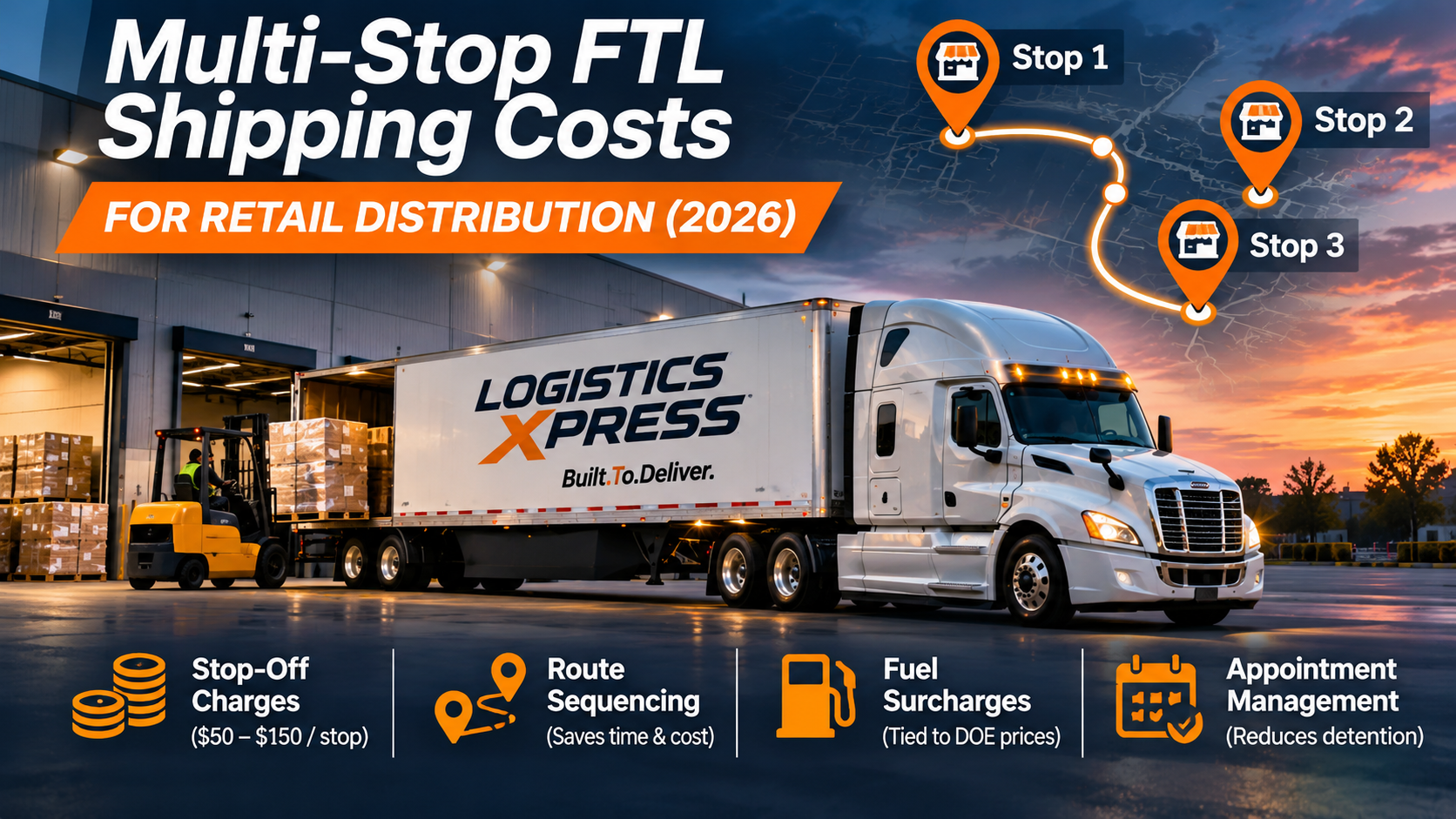
Multi-stop full truckload (FTL) shipping costs include the base linehaul rate, additional stop charges, fuel, and potential accessorial fees such as detention. For retail distributors, the total cost depends on route mileage, the number of delivery locations, appointment requirements, equipment type, and carrier availability.
Combining several retail deliveries into one truckload can reduce transportation costs when destinations are geographically aligned. However, poorly planned routes, inefficient loading sequences, and delays at receiving docks can quickly eliminate those savings.
This guide explains how multi-stop FTL pricing works, provides an example cost breakdown, compares multi-stop truckload shipping against separate FTL and LTL shipments, and outlines strategies retailers and manufacturers can use to control freight expenses.
Key Takeaways: Multi-Stop FTL Shipping Costs
- Pricing structure: Multi-stop FTL costs consist of linehaul, stop-off charges, fuel, and applicable accessorial fees.
- Route planning: Geographically clustered deliveries generally reduce unnecessary mileage and improve equipment utilization.
- Load sequencing: Loading freight in reverse delivery order can reduce unloading time and prevent unnecessary freight handling.
- Detention risk: Delays at one receiving location can affect every remaining delivery appointment.
- Mode selection: Multi-stop FTL is often worth comparing against separate truckloads and LTL when multiple deliveries originate from one facility.
- Carrier selection: Experienced multi-stop carriers and proactive appointment coordination help reduce service disruptions.
What Is Multi-Stop Full Truckload Shipping?
Multi-stop full truckload shipping is a transportation arrangement in which one dedicated truck picks up freight at an origin facility and delivers portions of the shipment to two or more destinations along a planned route.
Unlike less-than-truckload (LTL) shipping, the trailer is dedicated to one shipper's freight rather than being consolidated with freight from multiple customers through a terminal network.
For example, a manufacturer in Southern California might load one 53-foot dry van with merchandise destined for three retail distribution locations in Arizona and Nevada. Instead of arranging three separate trucks, the shipper can evaluate one multi-stop route.
This approach is commonly used for:
- Retail store replenishment
- Distribution center deliveries
- Consumer goods and packaged merchandise
- Store openings and fixture rollouts
- Regional warehouse distribution
- Recurring deliveries to multiple customer locations
The primary advantage is the ability to consolidate transportation activity while maintaining dedicated truckload capacity.
For a broader explanation of transportation modes, see the Logistics Xpress Freight Shipping Guide.
How Is Multi-Stop FTL Pricing Structured?
Multi-stop FTL pricing generally begins with a linehaul rate covering the planned route from pickup to final delivery. Carriers then account for additional delivery stops, fuel, equipment requirements, and any applicable accessorial charges.
The basic pricing formula is:
Total Multi-Stop FTL Cost = Linehaul + Stop-Off Charges + Fuel + Accessorial Fees
Each component affects the final transportation cost.
1. Base Linehaul Rate
The linehaul charge covers the truck, driver, and transportation service across the planned route.
Carriers consider total mileage, origin and destination markets, equipment availability, transit requirements, and the availability of return freight.
A route with several deliveries located directly along a major transportation corridor may be more economical than one requiring significant backtracking between destinations.
2. Stop-Off Charges
A stop-off charge compensates the carrier for the additional time and operational requirements associated with each delivery location.
These activities may include:
- Checking in at the receiving facility
- Waiting for an available dock
- Positioning the trailer
- Unloading the designated freight
- Collecting delivery documentation
- Departing for the next destination
For planning purposes, a shipper might model an additional stop at $100, but actual stop-off fees vary by carrier, route, contract, and service requirements.
Some carriers charge a flat fee per additional stop, while others use tiered pricing or provide one all-inclusive multi-stop rate.
3. Fuel Surcharges
Fuel may be included in an all-in truckload quote or calculated separately.
When fuel is billed separately, the carrier's surcharge methodology may reference the U.S. Energy Information Administration's published diesel price data.
The specific calculation depends on the carrier agreement. Shippers should confirm whether the fuel charge applies to planned route mileage, linehaul charges, or another contractual basis.
4. Accessorial Charges
Additional charges may apply when the shipment requires services beyond standard transportation.
Common multi-stop accessorials include detention, layover, truck ordered not used, re-delivery, liftgate service, and special delivery appointments.
Not every shipment will incur these charges. Confirm which services are included in the original rate and which may be billed separately.
How Much Does a 3-Stop FTL Shipment Cost?
Consider a hypothetical retail distribution shipment moving from one warehouse to three delivery locations using a 53-foot dry van.
The following example demonstrates how a multi-stop quote might be calculated.
| Cost Component | Example Amount |
|---|---|
| Base linehaul | $1,500 |
| Additional stop 1 | $100 |
| Additional stop 2 | $100 |
| Fuel surcharge | $300 |
| Detention | $0 |
| Total estimated cost | $2,000 |
This is an illustrative pricing example, not a current market quote or guaranteed rate.
In this example, the shipper pays $2,000 for the complete three-delivery route.
If one delivery location creates an additional $150 detention charge, the final cost increases to $2,150.
This illustrates why shippers should evaluate the complete transportation cost rather than comparing linehaul rates alone.
Important: Ask whether a carrier's quoted price includes all delivery stops, fuel, appointment requirements, and expected accessorials.
What Factors Affect Multi-Stop FTL Shipping Costs?
Several variables influence the rate a carrier offers for a multi-stop retail distribution route.
Distance and Route Geometry
Total route mileage is one of the primary pricing factors.
A shipment with three deliveries located along the same interstate corridor may be more efficient than a shipment with three destinations spread across different directions.
Route geometry matters because backtracking increases driving time, fuel consumption, and potential hours-of-service constraints.
Shorter multi-stop routes can also have relatively high per-mile costs because equipment positioning, driver time, and dispatch expenses are spread across fewer miles.
Lane Balance and Deadhead
Lane balance describes the availability of freight moving into and out of a transportation market.
Carriers often evaluate whether they can secure another paying shipment near the final delivery location.
If the final destination has limited outbound freight, the carrier may account for additional empty miles, commonly called deadhead.
This can make the final delivery location just as important as the origin when evaluating multi-stop pricing.
Equipment Type
Dry van trailers are commonly used for retail replenishment, consumer goods, and general merchandise.
Other freight may require:
- Refrigerated trailers for temperature-sensitive products
- Flatbed or specialized equipment for store fixtures and oversized materials
- Liftgate-equipped equipment for locations without suitable unloading facilities
Equipment requirements affect carrier availability and pricing.
Temperature-controlled freight may involve additional operating costs, fuel consumption, monitoring requirements, and specialized capacity.
Seasonal Demand
Retail freight demand can change throughout the year.
Holiday replenishment, promotional merchandise, store resets, and seasonal inventory programs may create periods of increased shipping activity.
When available truck capacity becomes limited relative to demand, carriers may adjust their pricing.
For recurring distribution programs, evaluating contracted capacity before expected demand peaks can improve budgeting and service consistency.
Dwell Time and Detention
Every additional delivery introduces another opportunity for a delay.
A driver may encounter a late dock assignment, receiving congestion, incorrect appointment information, or unloading delays.
If stop two takes longer than expected, the driver may miss the receiving window at stop three.
That delay can create detention, layover, or re-delivery expenses.
Detention allowances vary by agreement. Some contracts provide two hours of free time, while others use different thresholds.
Confirm the applicable free time and hourly charges before dispatch.
Multi-Stop FTL vs. Separate FTL vs. LTL: Which Costs Less?
The most economical shipping method depends on shipment size, geographic distribution, receiving requirements, and delivery urgency.
| Factor | Multi-Stop FTL | Separate FTL Loads | LTL |
|---|---|---|---|
| Trailer capacity | Dedicated | Dedicated per load | Shared |
| Delivery locations | Multiple per truck | One or more per truck | Multiple through carrier network |
| Freight handling | Generally limited | Generally limited | Often includes terminal handling |
| Appointment flexibility | Requires coordinated stops | Independently scheduled | Depends on carrier service |
| Pricing structure | Route plus stops | Each truckload | Shipment-specific rates |
| Best suited for | Clustered retail deliveries | Larger individual deliveries | Smaller shipments |
When Is Multi-Stop FTL More Economical?
Multi-stop FTL can offer cost advantages when several deliveries originate from one facility, fit safely within one trailer, and follow a practical delivery sequence.
Instead of paying for separate trucks and drivers, the shipper consolidates transportation into one planned movement.
However, multi-stop FTL is not automatically cheaper.
Long detours, strict receiving appointments, extended unloading times, and poor lane balance can increase the total cost.
When Are Separate FTL Loads Better?
Separate truckloads may be preferable when individual destinations require substantial trailer capacity, deliveries must occur simultaneously, or strict appointments make a combined route impractical.
Separate trucks also reduce the risk that a delay at one destination affects another shipment.
When Should Retail Shippers Use LTL?
LTL may be more economical when individual deliveries consist of relatively small quantities of freight and the shipper can accommodate the carrier's transit and delivery schedule.
For example, sending two pallets to several distant stores may be better suited to LTL than reserving an entire dedicated trailer.
The decision should consider pallet count, shipment weight, freight classification, accessorials, transit requirements, and total delivered cost.
For additional information, see the Logistics Xpress guides on FTL Shipping Costs and LTL Pallet Shipping Rates.
How Does Load Planning Affect Multi-Stop FTL Costs?
Load planning plays an important role in preventing avoidable delays, product damage, and operational complications.
Reverse Drop Order Loading
Reverse drop order means loading freight for the final delivery first and freight for the first delivery last.
In a standard rear-unloading dry van, this places the first delivery's freight closest to the trailer doors.
For example:
- Freight for Stop 3 is loaded toward the front of the trailer.
- Freight for Stop 2 is positioned in the middle.
- Freight for Stop 1 is loaded near the rear doors.
At each delivery location, the appropriate pallets can be accessed without unnecessary handling of freight intended for later stops.
This method can improve unloading efficiency and reduce the risk of damaged merchandise.
Pallet Configuration and Weight Distribution
Retail distribution loads frequently include mixed products, varying pallet heights, and different weight concentrations.
Removing freight at each delivery changes the remaining trailer load.
Shippers and carriers must consider proper weight distribution, axle limits, load securement, and stability throughout the entire route.
A loading plan should account for both the initial shipment and the freight remaining after each delivery.
Logistics Xpress can coordinate with warehouse teams and carriers to communicate delivery sequences, pallet information, and loading requirements before pickup.
How Does Carrier Selection Affect Multi-Stop FTL Pricing?
Not every truckload carrier is equally experienced with multi-stop distribution.
Some carriers primarily operate direct, point-to-point freight and may price additional stops less competitively because of the added scheduling requirements.
Carriers experienced in multi-drop retail routes may be better positioned to coordinate multiple appointments, manage delivery documentation, and communicate exceptions.
What Should You Ask a Carrier Before Booking?
Before selecting a carrier, confirm:
- Does the quoted rate include every scheduled delivery stop?
- How are additional stops priced?
- What detention allowances and hourly charges apply?
- Who coordinates delivery appointments?
- How will shipment tracking and delivery updates be communicated?
- What happens if one location delays the remaining route?
- Can the driver accommodate the required unloading sequence?
These questions help identify potential cost and service risks before the shipment moves.
Logistics Xpress works with vetted carrier capacity and coordinates truckload transportation based on lane requirements, equipment needs, and service expectations.
How Can Retail Distributors Reduce Multi-Stop FTL Costs?
Retailers and manufacturers can control several cost variables through better transportation planning.
1. Consolidate Deliveries by Region
Grouping deliveries geographically reduces unnecessary mileage and can improve truck utilization.
Instead of scheduling several trucks to deliver small quantities to nearby locations on different days, evaluate whether those shipments can move together.
2. Use Flexible Delivery Windows
Strict receiving appointments can limit routing options.
Where possible, broader delivery windows give carriers more flexibility to sequence stops and respond to unexpected delays.
This can reduce the likelihood of missed appointments and related charges.
3. Negotiate Rates for Recurring Routes
Retail distribution programs with predictable weekly or monthly volume may benefit from contracted transportation agreements.
Recurring lanes give carriers more visibility into expected equipment demand and route requirements.
For shippers, contracted pricing can improve cost forecasting and reduce reliance on individual spot-market quotes.
4. Plan Loading Around Delivery Sequence
Coordinate with the origin warehouse before loading.
Confirm pallet counts, delivery assignments, stacking limitations, and the order in which freight should be accessible.
Proper planning helps reduce unnecessary unloading and rehandling.
5. Review Freight Invoices
Multi-stop shipments create additional opportunities for billing discrepancies.
Review invoices for duplicate stop-off charges, incorrect detention, unapproved accessorials, and differences between quoted and invoiced services.
Maintain delivery records and supporting documentation to resolve discrepancies.
How Does Real-Time Tracking Help Reduce Multi-Stop Freight Costs?
Shipment visibility helps transportation teams identify delays before they affect subsequent deliveries.
For example, if a driver is delayed at the first receiving location, the operations team can communicate with the remaining destinations and determine whether appointments need to be adjusted.
Without timely updates, a missed appointment may not become apparent until the driver arrives at the next location.
Effective multi-stop visibility includes:
- Pickup confirmation
- Arrival and departure updates at each stop
- Estimated arrival information
- Exception notifications
- Delivery documentation and proof of delivery
Logistics Xpress provides shipment visibility and operational coordination to help customers manage delivery requirements across multi-stop truckload routes.
What Should Retail Shippers Expect From the 2026 FTL Market?
Multi-stop FTL rates remain dependent on regional truck capacity, fuel expenses, seasonal demand, and carrier operating costs.
National spot-market averages can provide useful context, but they do not represent a guaranteed price for a specific multi-stop route.
A carrier quoting a direct 500-mile truckload and a carrier quoting a 500-mile route with four deliveries are evaluating different service requirements.
Retail shippers should compare rates based on the full route, equipment requirements, stop count, delivery windows, and included services.
For current market context, shippers can reference sources such as the DAT Trendlines freight market reports, U.S. Energy Information Administration diesel price data, and American Trucking Associations industry publications.
These sources should supplement, rather than replace, lane-specific freight quotes.
How Does Logistics Xpress Support Multi-Stop Retail Distribution?
Logistics Xpress helps manufacturers, wholesalers, and retail distributors coordinate full truckload shipments with multiple delivery requirements.
Our transportation services include:
- Full truckload capacity through vetted carrier relationships
- Multi-stop route and appointment coordination
- Dry van, refrigerated, and specialized equipment solutions
- Shipment tracking and proactive communication
- Delivery documentation and proof-of-delivery coordination
- Freight cost reviews and accessorial oversight
Whether your business distributes merchandise to regional warehouses, retail stores, or multiple customer locations, our team can help evaluate transportation options based on cost, service requirements, and route efficiency.
Our approach focuses on giving shippers one accountable logistics contact while coordinating the carrier capacity and operational details required to complete each shipment.
Conclusion: How Can You Control Multi-Stop FTL Shipping Costs?
Controlling multi-stop full truckload costs starts with understanding the complete transportation requirements.
Linehaul pricing matters, but additional delivery stops, route geometry, fuel, detention, loading sequences, and carrier selection all influence the final cost.
Retail shippers should compare multi-stop FTL against separate truckloads and LTL, particularly when deliveries vary in size or geographic location.
For recurring distribution programs, coordinated appointment scheduling, accurate shipment information, and consistent carrier communication can improve both cost predictability and delivery performance.
Need pricing for a multi-stop retail distribution route?
Contact Logistics Xpress to request a multi-stop FTL freight quote. Share your pickup location, delivery stops, pallet counts, equipment requirements, and receiving windows so our team can evaluate your transportation options.
Built.To.Deliver.
Frequently Asked Questions About Multi-Stop FTL Shipping
How much does multi-stop FTL shipping cost?
Multi-stop FTL costs include the base linehaul rate, additional stop-off charges, fuel, and applicable accessorials. The total depends on mileage, number of stops, equipment, delivery requirements, and carrier availability. Request an itemized quote for accurate lane-specific pricing.
Is multi-stop FTL cheaper than separate truckloads?
Multi-stop FTL can be less expensive when multiple deliveries fit on one truck and follow an efficient route. However, long detours, extended unloading times, or restrictive appointments can reduce potential savings.
How are stop-off charges calculated?
Carriers may charge a flat amount per additional stop, use tiered fees, or include all stops in one negotiated rate. Pricing depends on the carrier, market, route, and delivery requirements.
What is the biggest cost risk in multi-stop FTL shipping?
One major risk is a delay at an early delivery stop that affects later appointments. This can result in detention, layover, missed delivery windows, or re-delivery charges.
How many stops can a full truckload shipment have?
There is no universal maximum number of stops. The practical limit depends on transit time, driver hours-of-service regulations, receiving appointments, route mileage, and carrier requirements.
When should I choose LTL instead of multi-stop FTL?
LTL may be preferable for smaller shipments that do not require dedicated trailer capacity or strict delivery control. Compare the total cost and service requirements of both options before booking.
Does multi-stop FTL require special loading?
Multi-stop shipments benefit from loading freight in reverse delivery order so pallets for the first stop are accessible first. Proper weight distribution and load securement must also be maintained throughout the route.
Can refrigerated trucks handle multi-stop deliveries?
Yes. Refrigerated trailers can handle multiple deliveries when temperature requirements, product compatibility, unloading procedures, and transit schedules are properly coordinated.
How does Logistics Xpress help with multi-stop freight?
Logistics Xpress coordinates vetted carrier capacity, delivery appointments, shipment visibility, and transportation documentation for multi-stop FTL shipments. Our team helps shippers evaluate routes and service requirements to support efficient retail distribution.