
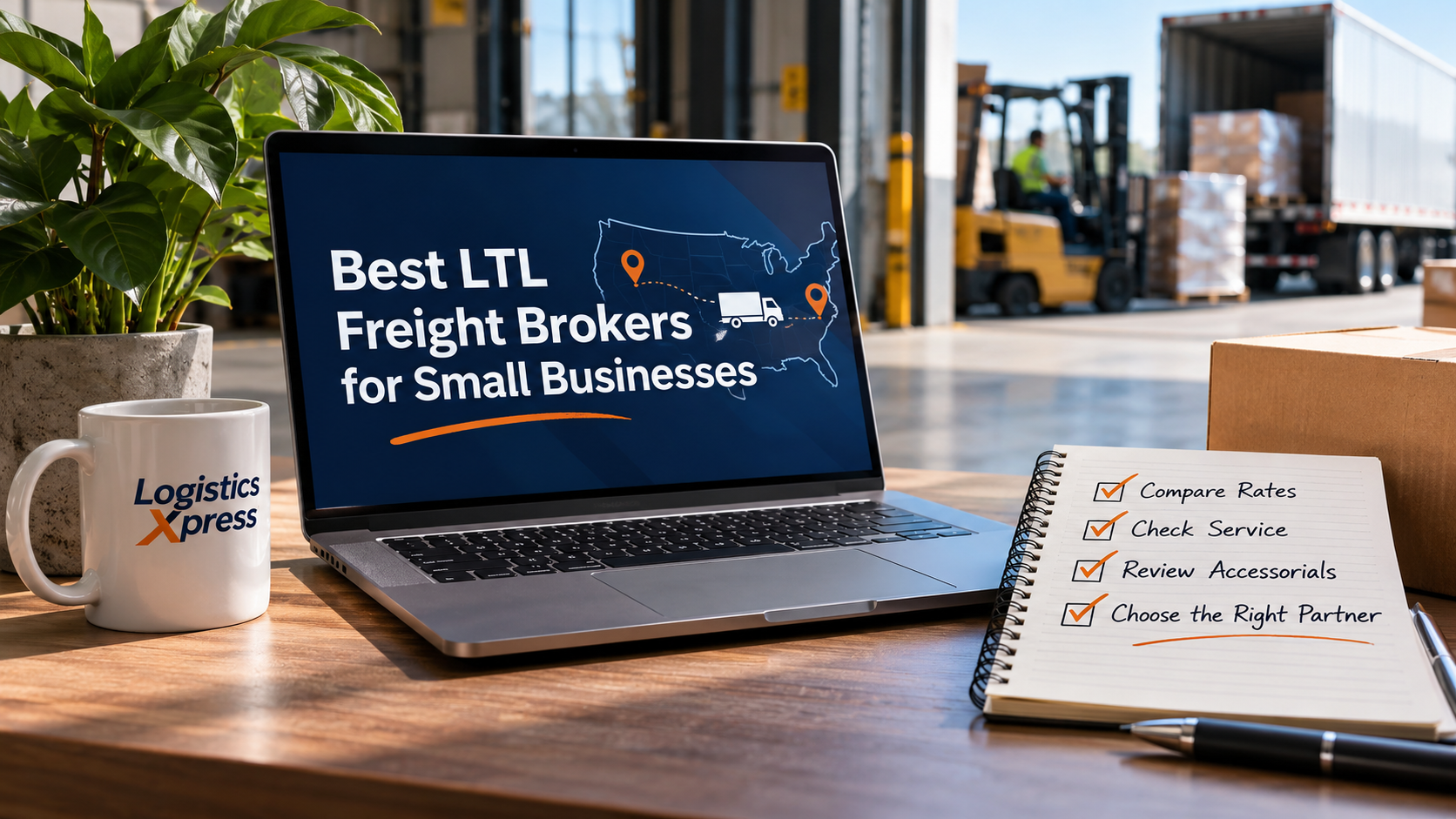
Small businesses shipping palletized freight need reliable transportation without paying for an entire truck. Less-than-truckload (LTL) shipping allows businesses to move smaller shipments while sharing trailer space with other shippers.
However, finding the right LTL freight broker can be challenging. Small businesses often face fluctuating shipping rates, unexpected accessorial charges, freight reclassifications, limited shipment visibility, and difficulty reaching someone when a delivery goes wrong.
Logistics Xpress helps small businesses compare LTL freight shipping options, coordinate pickups and deliveries, and manage shipments through a dedicated transportation team.
This guide compares six freight brokers and logistics providers for small businesses based on carrier access, shipment visibility, customer support, pricing transparency, and flexibility as shipping volumes grow.
Quick Answer: What Are the 6 Best LTL Freight Brokers for Small Businesses?
- Logistics Xpress: Best for small businesses seeking personalized service, competitive carrier options, and dedicated shipment coordination.
- TQL: Best for businesses looking for broad domestic carrier coverage and multimodal brokerage services.
- RXO: Best for businesses interested in technology-driven freight management and digital shipment visibility.
- Echo Global Logistics: Best for businesses that prefer online quoting, booking, and shipment management.
- J.B. Hunt: Best for growing businesses that may eventually need truckload and intermodal transportation.
- C.H. Robinson: Best for businesses seeking access to a large transportation network and multiple shipping modes.
The best choice depends on your shipment frequency, freight characteristics, shipping lanes, service requirements, and how much assistance your team needs.
How We Compared LTL Freight Brokers for Small Businesses
Small businesses have different transportation requirements than large manufacturers and national retailers.
A company shipping three pallets per week may need the same delivery reliability as a company shipping hundreds, but it may not have a dedicated logistics department or enough freight volume to negotiate substantial carrier discounts directly.
We considered six important factors.
- Pricing transparency: How clearly can businesses understand freight rates, fuel charges, and additional service fees?
- Carrier network: Does the provider offer access to regional and national carriers across different shipping lanes?
- Shipment visibility: Can customers receive tracking updates and delivery confirmation?
- Customer support: Is assistance available when shipments are delayed, damaged, or require special coordination?
- Freight flexibility: Can the provider handle occasional shipments, recurring freight, and changing pallet volumes?
- Scalability: Can businesses transition into volume LTL, partial truckload, or full truckload services as they grow?
These criteria help businesses compare providers based on overall transportation value rather than the lowest quoted rate alone.
The 6 Best LTL Freight Brokers for Small Businesses
1. Logistics Xpress: Best for Personalized LTL Freight Management
Logistics Xpress is a Las Vegas-based transportation management company helping businesses coordinate domestic and international freight through a network of more than 700 vetted carriers and asset-supported transportation resources.
For small businesses without an internal logistics department, Logistics Xpress provides a dedicated point of contact to assist with quoting, carrier selection, pickup scheduling, shipment tracking, and delivery coordination.
Rather than requiring businesses to contact multiple carriers individually, Logistics Xpress helps compare available transportation options and identify services suited to each shipment.
The company supports businesses shipping everything from occasional pallets to recurring LTL and full truckload freight.
Key Logistics Xpress Features
- Multiple carrier options: Access to regional and national transportation providers based on the shipment's origin, destination, and service requirements.
- Dedicated shipment support: A direct point of contact to coordinate pickups, communicate with carriers, and resolve transportation issues.
- Freight classification assistance: Help reviewing dimensions, weight, freight class, and other information that can affect shipping charges.
- Shipment tracking: Carrier tracking information, status updates, and proof-of-delivery coordination.
- Accessorial coordination: Assistance identifying liftgate, limited-access, appointment, and other delivery requirements before booking.
- Flexible freight solutions: LTL, volume LTL, partial truckload, FTL, refrigerated, flatbed, and other transportation services.
Businesses with changing shipment volumes can compare volume LTL and partial truckload shipping rather than relying on standard LTL for every shipment.
Pros
- Dedicated transportation support for businesses without an internal logistics department.
- Multiple carrier options rather than relying on one transportation provider.
- Assistance with freight classification, appointment scheduling, and delivery requirements.
- Ability to manage both occasional shipments and recurring freight.
- Access to additional transportation modes as business needs expand.
Considerations
- Logistics Xpress operates primarily as a transportation broker and management provider, so individual shipments are generally performed by partner carriers.
- Pricing depends on shipment characteristics, lane, carrier availability, and required services.
- Businesses should provide accurate freight details to receive the most reliable quotes.
Best for: Small manufacturers, wholesalers, distributors, retailers, and growing businesses that want a dedicated logistics partner rather than managing transportation entirely on their own.
2. TQL: Best for Broad Domestic Freight Coverage
Total Quality Logistics (TQL) is a large U.S. freight brokerage providing truckload, LTL, and additional transportation services.
Its extensive carrier network makes it an option for businesses shipping across multiple regions or managing different freight requirements.
Key Features
- Nationwide freight brokerage network.
- LTL and full truckload transportation.
- Shipment coordination and carrier communication.
- Around-the-clock operational support.
Pros
- Broad transportation coverage.
- Multiple shipping modes available.
- Suitable for businesses with varied freight requirements.
Considerations
- Service experience may vary depending on the assigned account team.
- Businesses should confirm the level of dedicated support available for their shipment volume.
- Rates and accessorial requirements should be compared on individual lanes.
Best for: Small businesses needing access to a broad domestic transportation network.
3. RXO: Best for Technology-Driven Freight Management
RXO is a freight brokerage and transportation technology provider offering truckload, LTL, and managed transportation services.
Its technology-focused approach may appeal to businesses that prefer digital tools for shipment management and transportation visibility.
Key Features
- Digital freight management tools.
- LTL and truckload brokerage services.
- Shipment visibility and tracking.
- Managed transportation options.
Pros
- Technology-focused transportation management.
- Access to multiple freight services.
- Centralized shipment information.
Considerations
- Businesses should confirm which digital features are available for their account.
- Support arrangements may differ by service.
- Rates depend on shipment details and carrier availability.
Best for: Small businesses comfortable using digital transportation platforms.
4. Echo Global Logistics: Best for Online LTL Quoting and Booking
Echo Global Logistics provides freight brokerage services supported by transportation management technology.
Its EchoShip platform allows eligible customers to manage activities such as freight quoting, booking, tracking, and shipment documentation.
Key Features
- EchoShip transportation management platform.
- Access to multiple LTL carriers.
- Online shipment booking and tracking.
- LTL and truckload services.
Pros
- Digital tools can simplify routine shipping tasks.
- Multiple carrier options.
- Centralized freight management capabilities.
Considerations
- Businesses should review which services and support options are included.
- Some shipments may require additional coordination outside standard online workflows.
- Special delivery services can affect final transportation costs.
Best for: Businesses that prefer online tools for managing frequent LTL shipments.
5. J.B. Hunt: Best for Businesses Expanding Into Larger Freight Volumes
J.B. Hunt offers transportation services that include truckload, intermodal, dedicated transportation, and brokerage solutions.
For small businesses expecting significant growth, its broader transportation network may provide options as shipment sizes increase.
Key Features
- Asset-based transportation operations.
- Intermodal and truckload services.
- Brokerage transportation options.
- Shipment visibility technology.
Pros
- Multiple transportation services.
- Strong intermodal capabilities.
- Options for larger or recurring freight programs.
Considerations
- Standard small-business LTL requirements may be served through brokerage arrangements.
- Not every service is appropriate for occasional pallet shipments.
- Businesses should confirm availability and pricing for their specific freight needs.
Best for: Growing businesses evaluating larger shipment volumes and multimodal transportation.
6. C.H. Robinson: Best for Businesses With Complex Transportation Needs
C.H. Robinson is a global logistics provider offering domestic freight brokerage, international transportation, and supply chain management services.
Its broad service portfolio may benefit small businesses that expect to expand into additional shipping modes or international markets.
Key Features
- Domestic LTL and truckload brokerage.
- International ocean and air freight services.
- Transportation management technology.
- Shipment tracking and reporting capabilities.
Pros
- Broad transportation network.
- Multiple domestic and international shipping services.
- Technology and logistics management resources.
Considerations
- Businesses should confirm account requirements and available support.
- A broad service portfolio may be more than occasional shippers need.
- Rates and services should be evaluated against shipment-specific requirements.
Best for: Growing businesses with domestic and international transportation requirements.
LTL Freight Broker Comparison for Small Businesses
| Provider | Primary Strength | Best Fit |
|---|---|---|
| Logistics Xpress | Dedicated support and flexible carrier options | Small businesses wanting hands-on service |
| TQL | Broad carrier network | Domestic freight coverage |
| RXO | Digital freight management | Technology-focused shippers |
| Echo Global Logistics | Online quoting and booking | Self-service freight management |
| J.B. Hunt | Truckload and intermodal resources | Growing freight volumes |
| C.H. Robinson | Multimodal and global services | Complex supply chains |
The right provider should offer competitive pricing on your actual shipping lanes while meeting your delivery, communication, and service expectations.
What Is LTL Shipping for Small Businesses?
LTL shipping allows multiple businesses to share space on the same truck.
Instead of paying for an entire trailer, a business pays for transportation based on factors such as shipment weight, dimensions, freight class, distance, and required services.
For example, a small manufacturer shipping two pallets of finished products from California to Texas may not need a dedicated truck.
An LTL carrier can transport those pallets alongside freight from other businesses, making the service a practical option for smaller shipments.
LTL is commonly used by:
- Manufacturers shipping parts, equipment, or finished goods.
- Wholesalers distributing products to retailers.
- E-commerce businesses replenishing warehouse inventory.
- Small retailers receiving palletized merchandise.
- Distributors shipping products to multiple customers.
How Much Does LTL Shipping Cost for Small Businesses?
LTL shipping costs depend on several shipment-specific factors rather than a fixed price per pallet.
The most important include:
1. Shipping distance: Longer routes generally increase transportation costs.
2. Shipment weight and dimensions: Carriers consider the freight's weight and the space it occupies.
3. Freight class: Freight classification can affect the rate based on density, handling, liability, and stowability characteristics.
4. Pickup and delivery requirements: Liftgates, residential deliveries, limited-access locations, and appointment services may create additional charges.
5. Carrier availability: Rates can vary by shipping lane, service level, and available capacity.
For a detailed breakdown, see our Complete Guide to Pallet Shipping Costs.
How Can Small Businesses Lower LTL Shipping Costs?
Small businesses can reduce avoidable freight expenses by improving how shipments are prepared and quoted.
Start with these practices:
- Provide accurate pallet dimensions and total shipment weight.
- Verify the correct freight class or applicable NMFC information.
- Identify liftgate and limited-access requirements before booking.
- Package freight securely to reduce damage risk.
- Compare regional and national carrier options.
- Consolidate smaller shipments when practical.
- Compare volume LTL or partial truckload pricing for larger shipments.
The lowest initial quote is not always the lowest final shipping cost.
A slightly higher rate with the correct services included may be less expensive than a cheaper quote that results in additional charges.
Should Small Businesses Use an LTL Freight Broker or Book Directly With a Carrier?
Small businesses can book LTL freight directly with carriers or work through a freight broker.
Booking directly with a carrier can work well when a business has consistent shipping lanes, established rates, and the resources to manage transportation internally.
Using an LTL freight broker gives businesses access to multiple carrier options through one transportation relationship.
A freight broker can help compare pricing, coordinate pickup requirements, communicate with carriers, and manage shipment exceptions.
For small businesses without dedicated shipping personnel, this additional support can reduce the administrative work involved in managing freight.
The best approach depends on shipment frequency, internal resources, and whether the business benefits from comparing multiple carriers.
When Should a Small Business Switch From LTL to Partial Truckload or FTL?
LTL is often a practical choice for smaller pallet shipments, but it is not always the most economical option as freight volume increases.
Businesses shipping several pallets on the same lane should consider comparing standard LTL with volume LTL and partial truckload services.
For larger shipments, full truckload shipping may provide advantages such as reduced freight handling, dedicated trailer capacity, and more direct transportation.
There is no universal pallet-count cutoff. The best option depends on shipment weight, dimensions, trailer space, distance, and delivery requirements.
Logistics Xpress can help businesses compare these transportation modes before selecting a service.
How Can Small Businesses Avoid Unexpected LTL Charges?
Unexpected LTL charges often occur when shipment details or delivery requirements differ from the information provided during quoting.
Common examples include:
- Freight reweighs.
- Freight reclassifications.
- Liftgate service.
- Limited-access pickup or delivery.
- Residential delivery.
- Inside delivery.
- Appointment or notification requirements.
- Detention or other applicable service fees.
To reduce these charges, businesses should confirm shipment details and special requirements before dispatch.
A freight broker can assist by reviewing shipment information, explaining potential accessorials, and helping resolve billing discrepancies when they occur.
Businesses can also use the Logistics Xpress freight class calculator as a starting point when preparing shipment information.
Why Small Businesses Choose Logistics Xpress for LTL Shipping
Small businesses need more than a freight rate. They need transportation that supports their customers, protects their products, and allows them to focus on running their business.
Logistics Xpress helps simplify freight management by providing access to multiple transportation providers through one dedicated team.
Whether a business ships one pallet occasionally or multiple shipments every week, our team can assist with carrier selection, freight coordination, tracking, and delivery communication.
As shipping requirements grow, businesses can also access additional transportation solutions, including volume LTL, partial truckload, FTL, refrigerated freight, flatbed, intermodal, and international transportation.
Looking for a more reliable way to manage your pallet shipments?
Request an LTL Freight Quote and let Logistics Xpress help you compare shipping options for your business.
Logistics Xpress — Built.To.Deliver.
Frequently Asked Questions About LTL Shipping for Small Businesses
What is the best LTL freight broker for a small business?
The best LTL freight broker depends on shipment volume, shipping lanes, customer service requirements, and pricing. Logistics Xpress is an option for businesses seeking dedicated transportation support and access to multiple carrier options.
Can a small business ship just one pallet?
Yes. LTL shipping is commonly used for shipments consisting of one or several pallets. The cost depends on weight, dimensions, freight class, distance, and any required services.
Is LTL shipping cheaper than full truckload?
LTL is often more economical for smaller shipments because businesses share trailer capacity. However, larger or heavier shipments may be more cost-effective through volume LTL, partial truckload, or FTL.
Do small businesses need a freight broker?
No. Businesses can arrange freight directly with carriers. However, a freight broker can simplify carrier comparisons, scheduling, shipment communication, and transportation management.
How can I get an accurate LTL freight quote?
Provide the pickup and delivery ZIP codes, pallet count, dimensions, total weight, freight class or commodity description, and any special service requirements.
What causes unexpected LTL shipping charges?
Common causes include incorrect weight or dimensions, freight reclassification, liftgate service, limited-access locations, and additional delivery requirements that were not included in the original quote.
Can I use the same freight broker for LTL and full truckload shipments?
Yes. Many freight brokers, including Logistics Xpress, coordinate LTL, volume LTL, partial truckload, and full truckload transportation through one provider relationship.
How can a small business reduce pallet shipping costs?
Businesses can reduce avoidable costs by using accurate freight information, comparing carrier options, consolidating shipments when appropriate, and selecting the right transportation mode for each load.